
Use our Forex Drawdown Calculator to accurately simulate how your trading account equity will be impacted after a series of losing trades, helping you develop better money management and stop-loss strategies.
What is Forex Drawdown?
Forex drawdown refers to the peak-to-trough decline in your account equity, expressed as a percentage. It represents the proportion of capital given back over a specific period. Excessive drawdown not only increases the risk of a stop-out, but also puts immense psychological pressure on a trader.
A drawdown calculator helps you simulate in advance the maximum equity drop your account could experience under different risk-per-trade settings and consecutive loss counts, helping you prevent unacceptable losses in live trading.
How to Use the Forex Drawdown Calculator
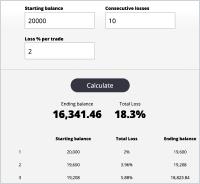
Starting Balance: Enter your current or planned account equity, for example, 1,000 or 20,000.
Consecutive Losses: Simulate how many trades you might lose consecutively in a worst-case scenario, such as 6, 10, or 20 trades.
Loss Percentage per Trade: Set the maximum risk percentage you plan to take per trade. It is generally recommended to keep it between 0.5% and 2% of your account equity.
After entering the parameters above, click "Calculate". The system will display the ending account balance, total loss amount, and the corresponding maximum drawdown rate, along with a detailed list of balance changes after each losing trade.
How to Interpret Drawdown Results?
If the simulation shows a drawdown consistently below 10%, it indicates conservative risk control. A drawdown between 20% and 30% reflects significant equity volatility. A drawdown exceeding 40% greatly increases the risk of a margin call/stop-out and emotional burnout, typically requiring a re-evaluation of your position sizing and trading system.
Using Alongside Other Risk Management Tools
Drawdown is just one part of overall risk management. When building your trading plan, we recommend using it alongside the Position Size & Risk Calculator and Risk of Ruin Calculator to comprehensively assess per-trade risk, consecutive losses, and stop-out probabilities, helping to smooth out your equity curve.
Forex Drawdown Calculation FAQs
1. What is considered a healthy drawdown in forex trading?
Generally speaking, keeping long-term drawdown within 10% is considered healthy. Temporary drawdowns between 20% and 30% are common in trend-following or high-volatility strategies, but require strong psychological preparation and proper risk management. A drawdown exceeding 40% usually indicates over-leveraged positions or system instability, requiring immediate adjustments.
2. Is drawdown calculated based on floating loss or realized loss?
This tool defaults to calculating drawdown based on "realized loss" (closed trade loss), which is better suited for evaluating actual system performance after execution. For practical risk control, it is also recommended to monitor floating losses, as excessive unrealized drawdown can also trigger stop-outs or margin calls.
3. How much risk should be taken on a single trade?
Most risk management models suggest keeping single-trade risk between 0.5% and 2% of account equity. You can test different risk percentages in the drawdown calculator to find a comfortable balance between risk tolerance and profit targets.
4. Is a smaller drawdown always better?
An extremely small drawdown usually reflects a very conservative strategy, which may result in lower returns. The key lies in finding the right balance between drawdown depth and return targets. Simulating different parameter combinations in the drawdown calculator helps you identify a risk-reward ratio tailored to your trading style.
5. How can drawdown results be used to optimize a trading system?
You can input your strategy's win rate, risk-reward ratio, and consecutive loss count from historical backtesting or hypothetical scenarios into the drawdown calculator. Observe how maximum drawdown changes with different position sizes, then adjust stop-loss levels, profit targets, and trade frequency to smooth out your equity curve.
6. How much profit is needed to recover from a drawdown?
The larger the drawdown, the higher the profit percentage required to recover to original equity. For instance, a 20% account drawdown requires approximately a 25% gain to break even, whereas a 50% drawdown requires a 100% gain to recover. Controlling drawdown size is far more vital than desperately chasing losses afterward.