XM swap fees are the overnight interest added to or taken from a position that is still open at 22:00 GMT. That cutoff is 3:30am India Standard Time the next calendar morning. A position opened at 21:59 GMT is included in that night’s charge or credit. A position opened at 22:01 GMT waits until the next cutoff. The dollar amount is not a single worldwide rate: the costs document’s USDJPY figure uses assumed interest rates, and the number that will actually post is the swap long or swap short on that symbol.
Holding a leveraged CFD past the cutoff can add a financing debit on top of the spread. It can also post a credit when you are on the higher-interest side. Neither result changes the fact that the position can lose money. For a reader in India, the clock conversion is the practical part; permitted forex dealing is a separate rule, covered later on this page.
The cutoff is 22:00 GMT, not midnight in India
The XM costs document defines swap, or rollover, as the interest for carrying an open position to the next day. It applies the rate to positions held at 22:00 GMT and says the account is debited or credited within about an hour. There is no separate rollover on Saturday or Sunday, when the market is closed. Banks still count weekend interest, which is why a later section of the same document uses a three-day charge on a chosen weekday.
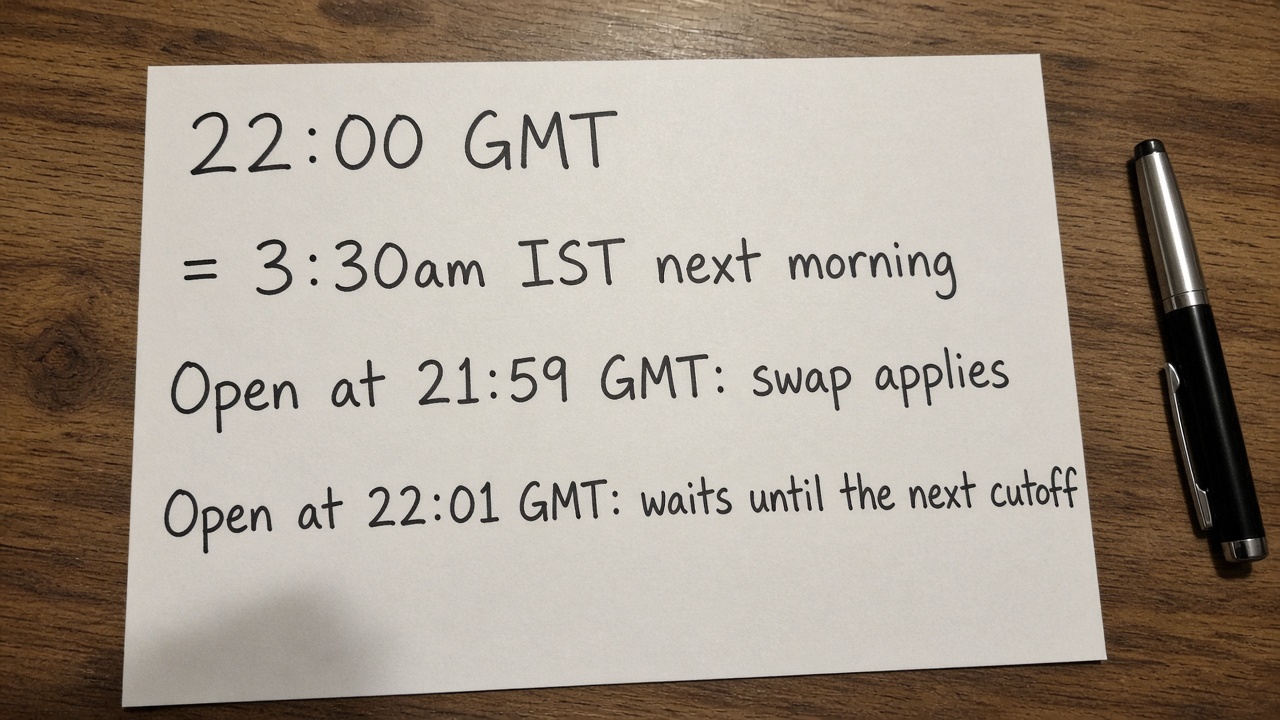
India Standard Time is five hours and thirty minutes ahead of GMT, so 22:00 GMT falls at 3:30am IST. Closing at 3:00am IST is still 21:30 GMT, so that night’s swap has not been applied. Closing at 3:31am IST is after the cutoff.
A UK order-execution note labels a similar session boundary as 22:00 UK time and also writes GMT beside it. During British Summer Time, UK civil time and GMT are an hour apart. If the platform server clock and the costs document disagree, use the server time shown in the terminal for that symbol, then match it to the document that belongs to the company on your client agreement.
How XM swap fees are calculated in the costs example
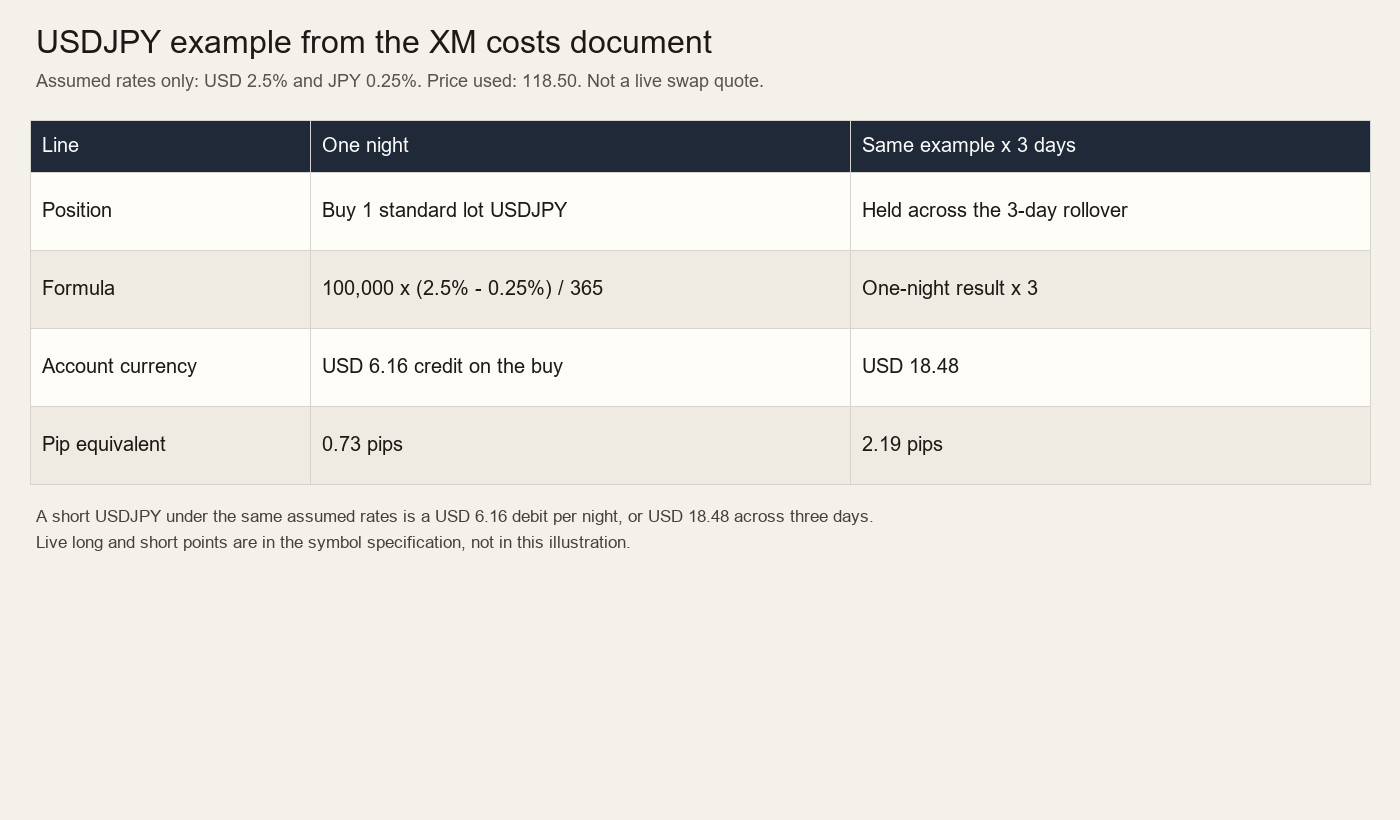
The same costs document walks through one buy of 1 standard lot of USDJPY, which is 100,000 units of the base currency. It assumes a US interest rate of 2.5% a year and a Japanese rate of 0.25% a year, and it uses a price of 118.50 only for the pip line. Those rates are assumptions inside the example. They are not today’s swap points.
The buy side earns the US rate and pays the yen rate. The document’s daily result is 100,000 × (2.5% − 0.25%) / 365 = USD 6.16, credited on that long position. It also calls that about 0.73 pips, from 118.50 × (2.5% − 0.25%) / 365. The short side, under the same assumptions, is a USD 6.16 debit per night. Source: XM costs and charges PDF.
| Line | One night | Same example across 3 days |
|---|---|---|
| Position | Buy 1 standard lot USDJPY | Held across the three-day rollover |
| Formula | 100,000 × (2.5% − 0.25%) / 365 | One-night result × 3 |
| Buy side | USD 6.16 credit | USD 18.48 credit |
| Sell side, same assumptions | USD 6.16 debit | USD 18.48 debit |
| Pip line in the document | 0.73 pips | 2.19 pips |
The three-day column is this page applying the document’s own one-night result to the three-day rule. The PDF states the one-night maths and, separately, the three-day weekday. It does not print USD 18.48 as a current quote. A 0.1 lot is one tenth of a standard lot, so the same assumptions would scale the one-night figure to about USD 0.62. Live points still have to come from the symbol, because the markup over the interbank rate is already inside the platform figure and can move.
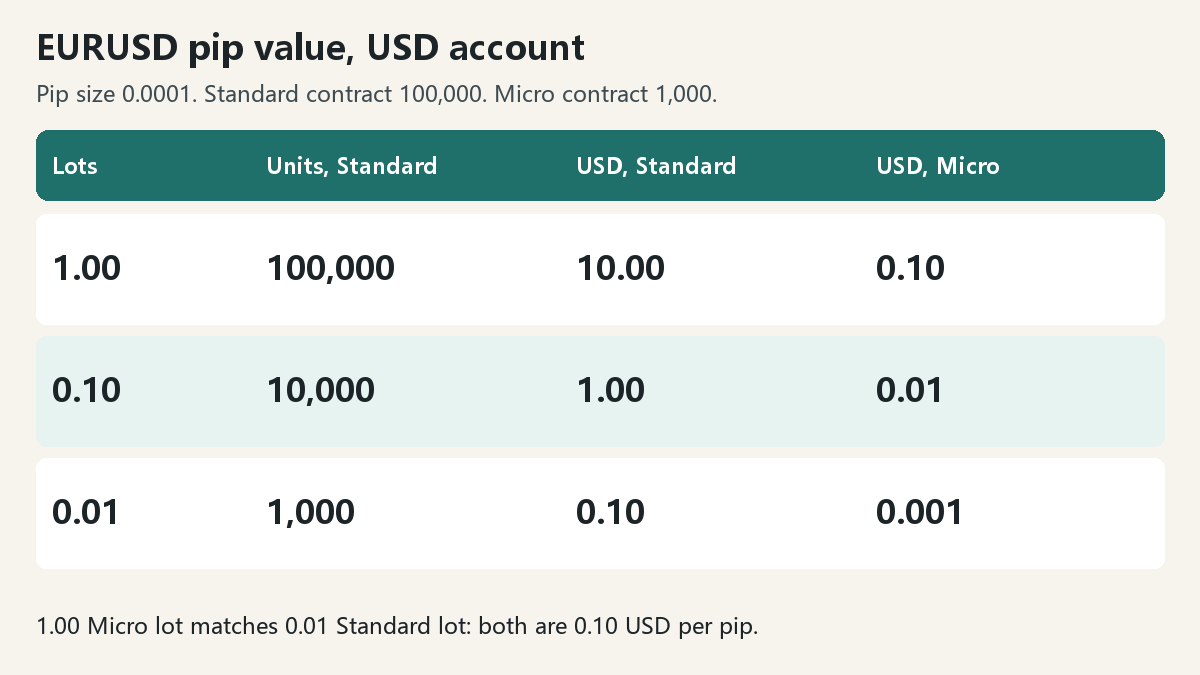
To turn a pip count into account currency after you have read the specification, a pip calculator only estimates pip value. It does not fetch the overnight points.
Wednesday is not the triple day for every symbol
The system costs PDF says there is no rollover on Saturday and Sunday. To cover the weekend, it applies a three-day rollover on Wednesday for CFDs on currencies and precious metals, and on Friday for CFDs on cash indices, cash energies and stocks. A shorter Cyprus costs extract also places a three-day rollover on Wednesday at 22:00 GMT. The Friday split is in the system PDF, so the file that matches the company on your agreement is the one to keep.
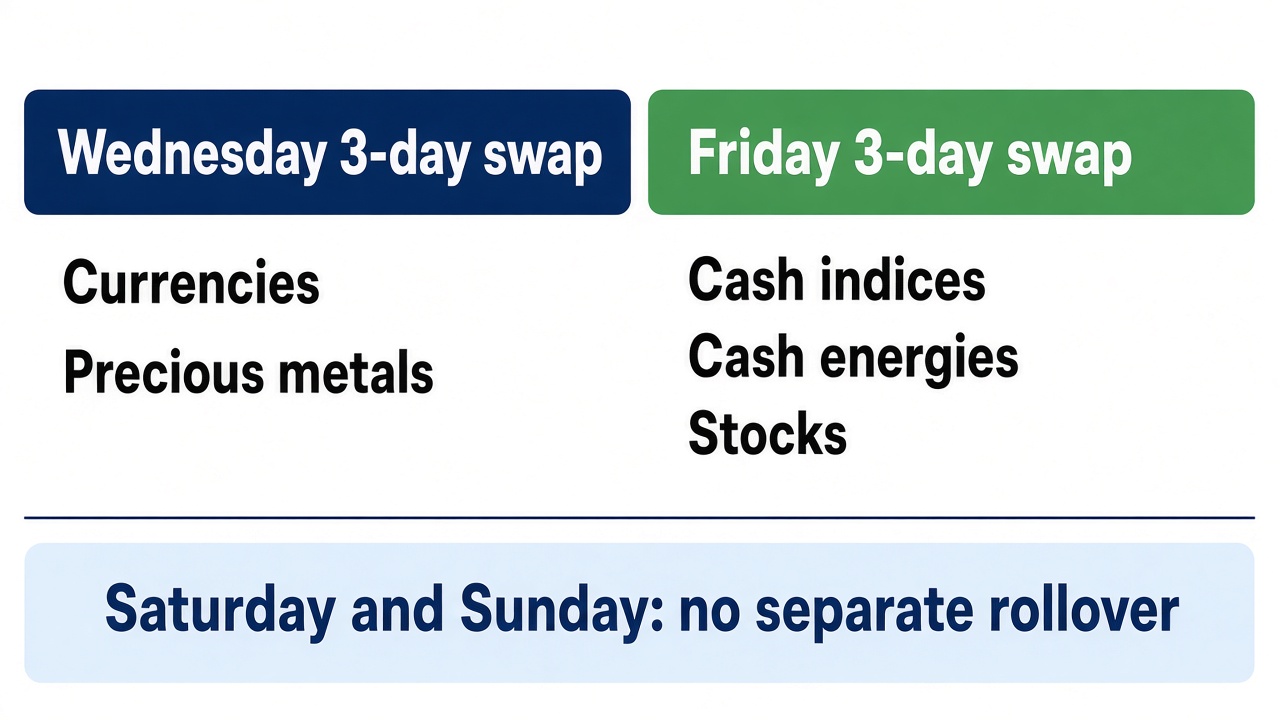
For a euro or gold position, the expensive night is the Wednesday cutoff, which is 3:30am IST on Thursday. For a cash index, cash energy or stock CFD, tripling the Friday cutoff means the charge posts at 3:30am IST on Saturday. Closing an index five minutes before that Friday cutoff avoids that triple. Closing it on Wednesday does not, because Wednesday is the FX and metals day in this document.
Swap is not the spread and it is not the commission. The spread is the bid-offer gap on entry and exit. Commission, where an account type charges one, is a per-trade fee. Those two are covered in how XM spreads are checked and how XM commission is charged. A position can pay all three.
Read swap long and swap short on the symbol
In MT4 or MT5, right-click the symbol in Market Watch and open Specification. The fields that matter are swap long and swap short, plus the swap type, which tells you whether the points are in price points, account currency, or another unit. The costs example’s “buy earns, sell pays” pattern is only true under its assumed rate gap. On a live symbol the sign can flip, and either field can be negative once the markup is included. Hold the side you actually have, and use that field.
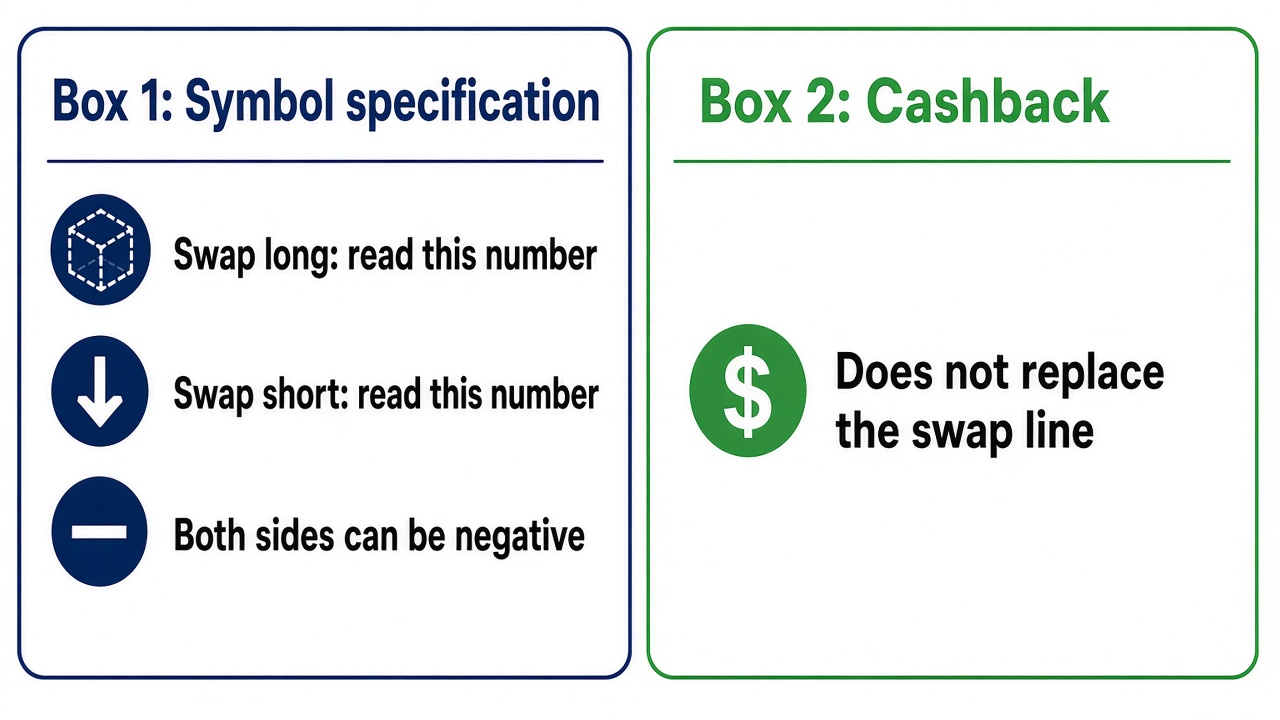
Points are usually quoted for 1 standard lot and then scaled by volume and by the number of nights, with the triple night counted as three. If the specification and a marketing table disagree, keep the specification for the server you are logged into. The company named on the client agreement is the one whose costs file and server apply. A second XM company can publish a different schedule.
Cashback does not replace the overnight charge
A rebate or cashback payment is tied to trading volume, usually the spread side of the cost. It does not rewrite swap long or swap short, and it does not turn a Wednesday triple into a single night. Net cost is spread, plus commission if any, plus swap, minus whatever cashback actually posts. The arithmetic for the cashback piece is in rebate per lot and net trading cost and the rebate calculator. The calculator output is an estimate, not the terminal’s swap.
The XM rebate profile is a screening card for account and cashback fields. Its leverage or deposit line is not an overnight rate. Do not copy a card figure into a multi-day holding plan. If an account name elsewhere says swap-free, the specification still has to show a zero overnight figure on that symbol before you treat the hold as free of financing.
What this means for a reader in India
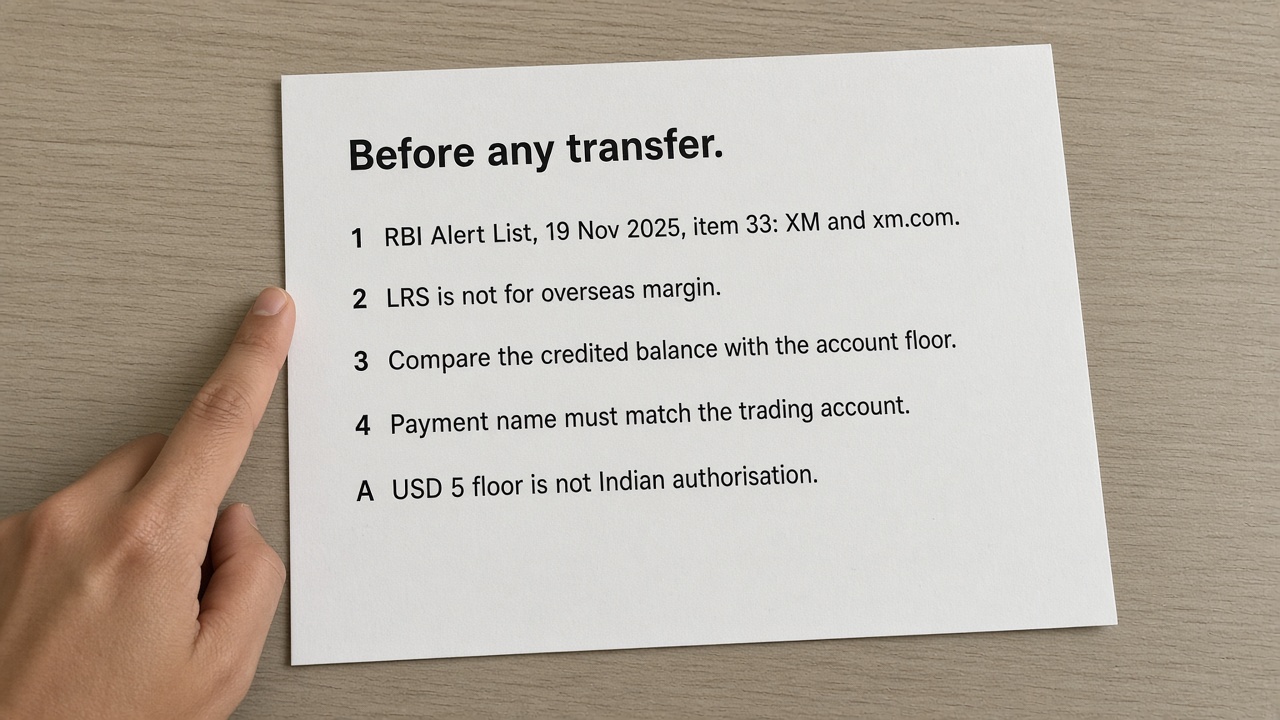
The Reserve Bank of India says resident persons may undertake forex transactions only with authorised persons and for permitted purposes under the Foreign Exchange Management Act, 1999. Permitted electronic forex should be done only on an RBI-authorised electronic trading platform or on NSE, BSE or MSE. Transactions on an unauthorised platform can lead to penal action under FEMA. See the RBI FAQ on forex transactions, updated 28 August 2024.
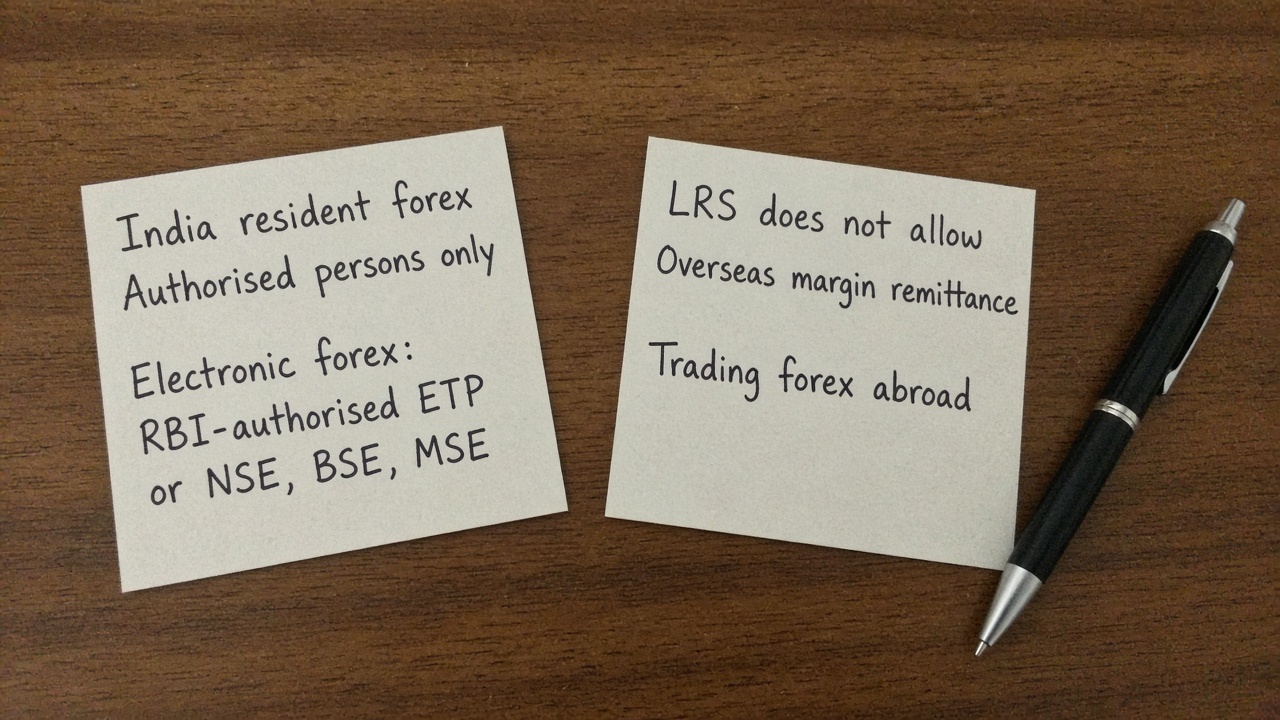
Under the Liberalised Remittance Scheme, the RBI’s list of purposes that are not permitted includes remittance from India for margins or margin calls to overseas exchanges or counterparties, and remittance for trading in foreign exchange abroad. The LRS FAQ is the list to read. This page explains how an overnight charge is calculated. It does not describe moving money offshore to pay margin.
Whether a particular XM company appears on an Indian authorisation list is a separate check from the swap formula. That residency question is already set out in whether XM is allowed in India and how XM regulation is checked for India. Knowing that 22:00 GMT equals 3:30am IST does not change those rules.
FAQ
What are XM swap fees?
They are the overnight financing debit or credit on a position that is still open at the rollover time. The costs document sets that time at 22:00 GMT and says the posting happens within about an hour. The size depends on the symbol, the side, the volume and whether that night is a three-day night.
What time do XM swap fees hit in India?
22:00 GMT is 3:30am India Standard Time the next calendar morning. A position closed at 3:00am IST has not yet reached the cutoff. One still open at 3:30am IST has. During British Summer Time, a note that says “UK time (GMT)” can be an hour away from plain GMT, so check the server clock.
Does a trade opened at 22:01 GMT pay swap that night?
No. The costs document says a position opened at 22:01 GMT is not subject to rollover until the next day. A position opened at 21:59 GMT is included at the 22:00 GMT cutoff. The one minute is the whole difference.
Why is Wednesday heavier on currencies than on indices?
The system costs PDF puts the three-day rollover on Wednesday for currency and precious-metal CFDs, and on Friday for cash indices, cash energies and stocks. Weekend interest is bundled into that weekday because Saturday and Sunday have no separate rollover. An index held over Wednesday is not on the FX triple day in that document.
Is USD 6.16 the current USDJPY swap?
No. USD 6.16 is the costs document’s one-night result for a 1-lot USDJPY buy using assumed rates of 2.5% and 0.25%. The short side in that illustration is a USD 6.16 debit. Multiplying by three produces USD 18.48 only inside that same illustration. Read swap long and swap short on the symbol for the live points.
Where are the live swap points?
In MT4 or MT5, open Market Watch, right-click the symbol and choose Specification. Use the swap field for the side you hold, and check the swap type so you know the unit. If that screen and a brochure disagree, the server you are logged into is the figure that will post.
Can both the long and the short swap be a cost?
They can. The PDF example has a credit on the buy and a debit on the sell only because of the rate gap it assumed. Once a markup is inside the quoted points, either field on a live symbol can be negative. Read the side you hold instead of assuming the other side always pays you.
Does cashback cancel a negative swap?
No. Cashback changes part of the trading cost, usually linked to volume. It does not edit the swap fields and it does not remove a triple night. Net cost still includes spread, any commission, and swap. A rebate calculator does not replace the symbol specification.
Is swap the same thing as the spread or the commission?
No. The spread is the bid-offer difference when you deal. Commission is a separate per-trade charge on account types that use one. Swap is the overnight financing for a position that stays open through 22:00 GMT. A single trade can include all three.
Does a 0.1 lot pay one tenth of the 1-lot example?
Under the document’s own formula, yes, because the charge scales with size. One tenth of USD 6.16 is about USD 0.62 per night, and about USD 1.85 across a three-day night, still using the assumed 2.5% and 0.25% rates. The live specification may not match that illustration.
What if an account is described as swap-free?
Open the symbol specification before you hold the position overnight. A zero in the swap field for your side is what shows that this symbol is not charging overnight interest. A non-zero figure means financing still applies, whatever name sits on a comparison card.
Which company’s swap rules apply?
The company printed on the client agreement. XM publishes more than one costs file, and a Cyprus extract and the system PDF do not phrase the triple day in identical length. Use the file for that company, then the specification on the server you trade.
Can a resident in India use this explanation to send margin offshore?
No. RBI requires resident forex to go through authorised persons, and electronic forex through an authorised platform or NSE, BSE or MSE. The LRS FAQ lists overseas margin remittances and remittances for trading foreign exchange abroad among purposes that are not permitted. This page only explains the charge.
Does knowing the IST cutoff make an offshore account permitted?
No. The time conversion only tells you when a financing debit or credit would post. Permission for a resident to deal in forex is set by FEMA and the RBI lists, not by the rollover clock. Use the India eligibility pages on this site for that check, and the RBI FAQ for the rule itself.