No. XM is not regulated or authorised by the Reserve Bank of India. The RBI Alert List dated 19 November 2025 names XM at item 33. Some XM-related companies hold licences overseas, but those licences do not give XM permission to deal in forex or operate a forex electronic trading platform in India.
That distinction is the heart of the issue. “Regulated” is not a group-wide label that travels across borders. It attaches to a specific legal entity, for defined services, in a particular jurisdiction. An India-based reader therefore has to ask two separate questions: which company would hold the account, and is the proposed activity authorised under Indian rules?
This is a general regulatory explainer, not personal legal advice. Rules can change, and the facts may differ by transaction, residency and contracting entity. Check the current RBI records and obtain qualified advice before opening, funding or using an overseas forex account.

Is XM Regulated in India? The Short Answer
XM is not an RBI-regulated forex broker and does not appear in RBI records as an authorised person or authorised forex electronic trading platform. More importantly, the RBI Alert List includes XM at item 33.
This does not mean every company associated with the XM brand is unregulated everywhere. XM’s global-facing legal materials identify XM Global Limited as regulated by the Belize Financial Services Commission. The CySEC register separately records Trading Point of Financial Instruments Ltd under licence 120/10 and identifies xm.com as an approved domain. Those are foreign regulatory facts about named entities. Neither record is an RBI authorisation for India.
For a resident of India, the RBI/FEMA position is the relevant local layer. A foreign licence may help answer who supervises a particular overseas company. It does not answer whether an Indian resident may lawfully undertake the proposed forex transaction through that company.
What the RBI Alert List Says About XM
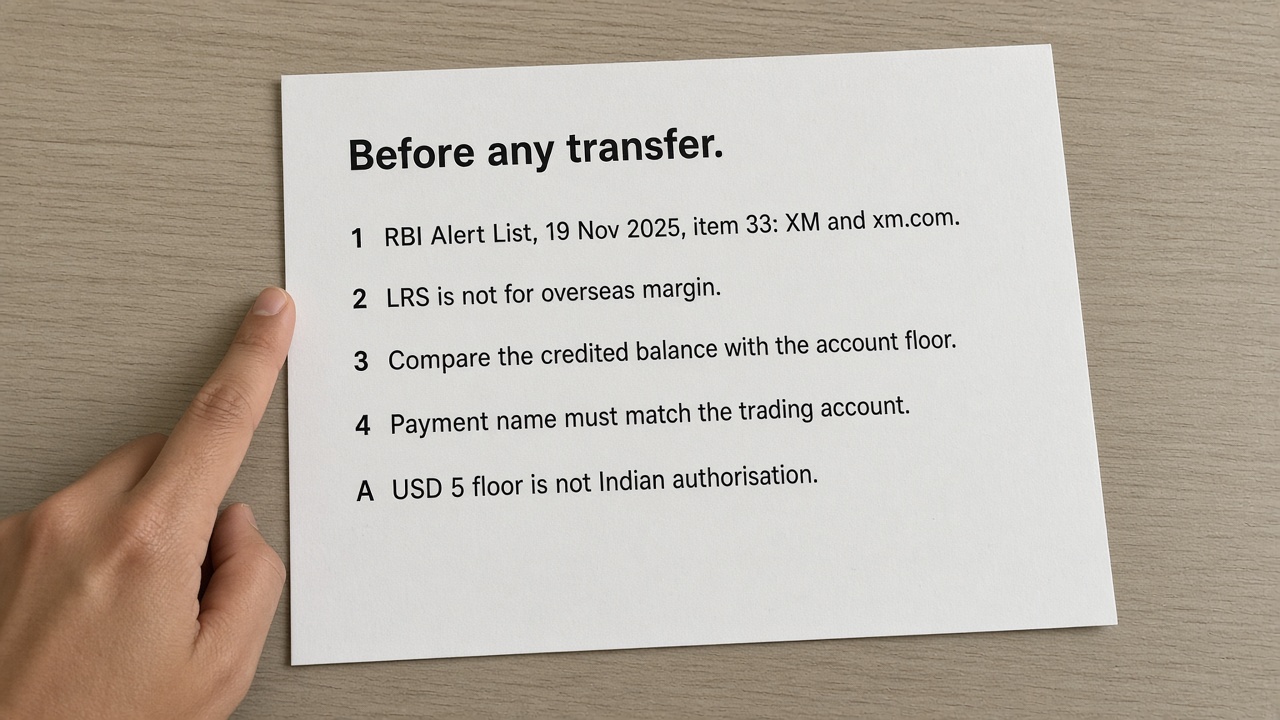
The RBI official Alert List page is dated 19 November 2025. XM and xm.com appear at item 33.
RBI explains that the list includes entities that are neither authorised to deal in forex under the Foreign Exchange Management Act, 1999 (FEMA) nor authorised to operate a forex electronic trading platform under the applicable RBI Directions. It can also include websites that appear to promote unauthorised entities or platforms.
That is why “XM is on the RBI Alert List” is accurate, while “RBI has proved XM is a scam” would go beyond the source.
Overseas Regulation Is Not Indian Authorisation
A broker brand can be used by several companies. Each company may have a different regulator, client agreement, product range and geographic scope. The logo on a website cannot tell you which entity would be your counterparty.

| Question | Evidence that answers it | What it does not prove |
|---|---|---|
| Which company holds the account? | Account-opening disclosure and client agreement | Group-wide authorisation |
| Is that company licensed overseas? | The named foreign regulator’s public register | Permission to operate in India |
| Is the platform authorised for forex in India? | RBI authorised-person and authorised-ETP records | A foreign licence or app-store listing |
| Is the name on the Alert List? | RBI’s current Alert List | That an unlisted name is approved |
| Can a proposed payment be made? | FEMA/RBI rules applied to the actual purpose and route | That a successful card or bank transfer is compliant |
What XM’s overseas records show
XM’s global-facing legal materials identify XM Global Limited as regulated by the Belize Financial Services Commission under licence 8557558. Separately, the CySEC public register records Trading Point of Financial Instruments Ltd under licence 120/10.
Neither entry should be applied blindly to an account. The exact contracting entity can vary by location and onboarding route. Read the client agreement presented to the user and match its company name and licence number to the regulator’s own register.
XM’s client agreement also makes the territorial issue clear: access to an online facility does not itself mean its use is legal in the user’s country. Availability is a technical fact, not regulatory approval.
How India’s Forex Rules Apply to Resident Traders
RBI’s Foreign Exchange Transactions FAQ states that resident persons may undertake forex transactions only with authorised persons and for permitted purposes under FEMA. For electronic forex transactions, RBI points residents to RBI-authorised electronic trading platforms or recognised stock exchanges—NSE, BSE and MSE.
The FAQ also says residents who undertake forex transactions for non-permitted purposes or on unauthorised electronic trading platforms can face penal action under FEMA. This is why the relevant test is not simply whether a broker accepts an Indian phone number, offers INR payment options or provides customer support in India.
Authorised person
An authorised person is not merely a company with a financial-services licence somewhere in the world. It is a person or institution authorised under FEMA for the relevant foreign-exchange activity. RBI’s official records—not a broker badge or affiliate claim—are the reference point.
Authorised electronic trading platform
An electronic trading platform (ETP) is a system through which eligible financial-market transactions are contracted. RBI issued the Electronic Trading Platforms (Reserve Bank) Directions, 2025 on 16 June 2025, superseding the 2018 Directions. A platform covered by this framework needs the relevant RBI authorisation; an overseas broker licence is not a substitute.
Recognised exchanges
RBI’s FAQ names NSE, BSE and MSE as recognised exchanges for permitted electronic forex transactions. The available products, eligible participants and contract specifications are governed by the applicable Indian framework. “Forex trading” is too broad a phrase to decide legality without looking at the product, purpose, venue and counterparty.
LRS does not solve the margin question
The Liberalised Remittance Scheme is sometimes treated online as a general-purpose route for funding an overseas trading account. RBI’s FAQ says remittance under LRS cannot be used for margin or margin calls to overseas exchanges or overseas counterparties for online forex trading. A payment that is technically possible is not necessarily a permitted remittance.
Does the RBI Alert List Mean XM Is Banned or Fraudulent?
“Banned” is often used as shorthand, but it obscures what the RBI source actually establishes. The Alert List says XM is not authorised to deal in forex under FEMA or operate a forex ETP under the RBI framework. It warns residents not to infer approval from availability, advertising or an absent name.
The list does not say that every XM group company lacks foreign regulation. Nor is it a court judgment on fraud. The practical result is still significant: an India-based user should not treat XM’s overseas licences, website access or promotional material as permission to undertake forex activity through XM from India.
How to Verify a Forex Broker for Use in India
Use this five-step check before considering any deposit, transfer or account link.
Identify the exact legal entity. Find the company name, registered address and governing-law clause in the client agreement. A brand name alone is not enough.
Check any overseas licence at the regulator. Search the official public register by legal entity and licence number. Confirm the approved domain and permitted services. Do not rely on a badge or affiliate page.
Check Indian authorisation separately. Use RBI’s records for authorised persons and authorised ETPs. If the activity is exchange-traded, verify the recognised exchange and applicable contract.
Search the current RBI Alert List. Look for the brand, legal entity, domain and close spelling variants. Remember that absence is not approval.
Review funding and product rules. Check whether the purpose, instrument, counterparty and remittance route are permitted. For uncertainty, consult a lawyer or compliance professional familiar with FEMA.
Save copies of the records you relied on and note the date checked. Regulatory pages, entity assignments and client terms can change.

Claims That Do Not Prove India Authorisation
These signals may look reassuring, but none answers the RBI question:
The website opens in India.
The app appears in an app store.
The broker accepts Indian contact details.
Customer support is available in English or Hindi.
INR appears as a display, deposit or conversion option.
A foreign regulator supervises one company in the group.
An influencer, affiliate or rebate site says the broker is “regulated.”
The brand does not appear in an old copy of the Alert List.
The reliable approach is to match the exact entity and activity to current official records.
What XM Cashback Changes—and What It Does Not
A cashback or rebate arrangement may return part of a partner commission after eligible trading activity. It can affect the trader’s net transaction cost if all programme conditions are met. It does not change the broker’s authorisation, make a prohibited transaction permitted, reduce leverage risk or guarantee that a payment route complies with FEMA.
Our separate guide to XM Cashback India explains the mechanics and cost calculation. Read the regulatory question first. The XM broker overview can provide product context, but the client agreement and regulator registers remain controlling for entity and licence claims.
This website is an independent information publisher. Read how xmforexcashback.in approaches research, and do not treat editorial or affiliate content as regulatory approval.
A Decision Framework for an India-Based Reader
If your goal is permitted currency trading through an Indian route, start with the venue and counterparty, not the brand’s global marketing. Check the recognised exchanges and authorised intermediaries relevant to the intended product. The site’s broker information hub can help organise research, but RBI and exchange records should be the final reference for Indian authorisation.
If you already have an overseas account, do not assume that past deposits, withdrawals or executed trades establish compliance. Preserve your contracts and transaction records, stop relying on promotional claims, and obtain individual advice on your position. This article cannot determine the legal consequences of a specific account or transaction.
Frequently Asked Questions
Is XM legal in India?
That question is broader than a broker status check. What can be stated precisely is that XM is not authorised or regulated by RBI for forex dealing or operation of a forex electronic trading platform, and XM appears on RBI’s Alert List. Whether a specific action breaches FEMA depends on the product, purpose, counterparty and payment route; obtain qualified advice for your facts.
Is XM on the RBI Alert List?
Yes. The RBI Alert List dated 19 November 2025 includes XM and xm.com at item 33.
Is XM regulated in India?
No. XM does not appear as an RBI-authorised person or authorised forex ETP, and RBI includes XM on its Alert List.
Is XM regulated anywhere?
Some named XM-related companies report overseas regulation. XM’s global-facing materials identify XM Global Limited as regulated by Belize’s Financial Services Commission, while the CySEC register records Trading Point of Financial Instruments Ltd under licence 120/10. These records do not create Indian authorisation and may not identify the entity offered to a particular user.
Does CySEC regulation make XM authorised in India?
No. CySEC supervises licensed entities within its jurisdiction. A CySEC licence does not replace the authorisation required under India’s RBI/FEMA framework.
Does the RBI Alert List mean XM is a scam?
No such conclusion should be drawn from the list alone. RBI uses it to identify unauthorised forex entities, ETPs and some promoters. Inclusion establishes a lack of the relevant RBI authorisation; it is not, by itself, a fraud conviction.
Is the RBI Alert List exhaustive?
No. RBI expressly says the list is not exhaustive. A broker missing from the list should not be assumed to be authorised.
Can an Indian resident use LRS to fund an overseas forex account?
RBI’s FAQ says LRS cannot be used to remit margin or margin calls to overseas exchanges or overseas counterparties for online forex trading. Other remittances depend on their purpose and the applicable rules; ask an authorised dealer or qualified adviser about a specific payment.
Which platforms can Indian residents use for electronic forex transactions?
RBI says permitted electronic forex transactions should be undertaken on RBI-authorised ETPs or recognised stock exchanges, namely NSE, BSE and MSE. The particular product and transaction must also be permitted.
Does an INR deposit option prove RBI approval?
No. A currency display, local payment method or successful transfer is not evidence that the broker or platform is authorised by RBI or that the remittance purpose is permitted.
Does XM cashback make the account compliant in India?
No. Cashback changes neither the contracting entity nor the regulatory status of the platform. It is only a conditional cost arrangement and cannot convert an unauthorised transaction into an authorised one.
Where should I verify XM’s status before acting?
Check the current RBI Alert List, RBI authorised-person and authorised-ETP records, the exact XM client agreement, and the relevant foreign regulator’s register for the named contracting entity. Use official sources rather than screenshots or affiliate claims.
Sources and Editorial Note
Reserve Bank of India: Electronic Trading Platforms Directions, 2025
CySEC: Trading Point of Financial Instruments Ltd register entry