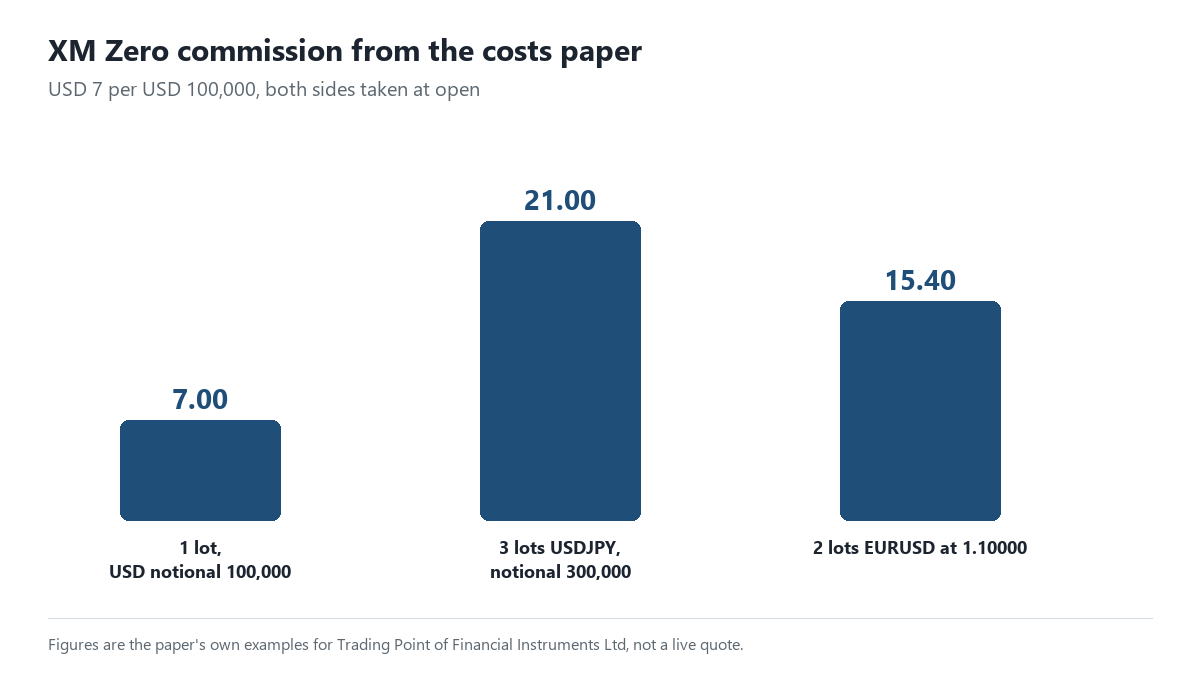
XM commission, on the costs paper of Trading Point of Financial Instruments Ltd, is a separate fee and it is named for XM Zero accounts only. The paper sets it at USD 7 for every USD 100,000 of transaction size, split into USD 3.50 when the position opens and USD 3.50 when it closes, and it takes both amounts at the open. A buy of 3 lots of USDJPY is USD 21. A buy of 2 lots of EURUSD at 1.10000 is USD 15.40. The same section does not put this commission on the other account types in the paper.
The company printed on the client agreement decides whether that table is yours. A public forex page can name a different company, and that company's schedule is the one that applies. Spread, overnight swap, and a dormant fee are different lines. A cashback arranged on xmforexcashback.in changes money that comes back after the trade. It does not erase a commission the broker has already taken when the position opened.
Where the XM commission line actually appears
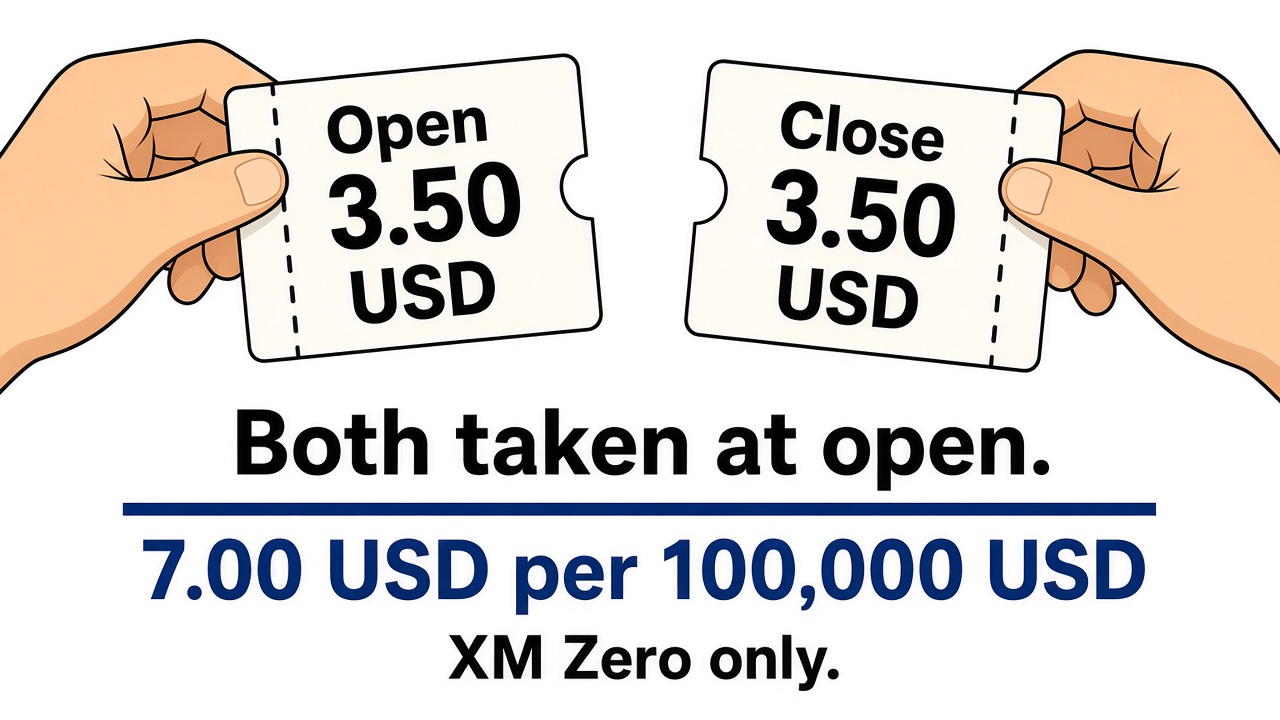
The commission section of the costs and charges paper is short. It covers XM Zero. The stated rate is USD 7 per USD 100,000 round turn, which the paper writes as USD 3.50 on the opening and USD 3.50 on the closing. Both are deducted from the account when the transaction opens.
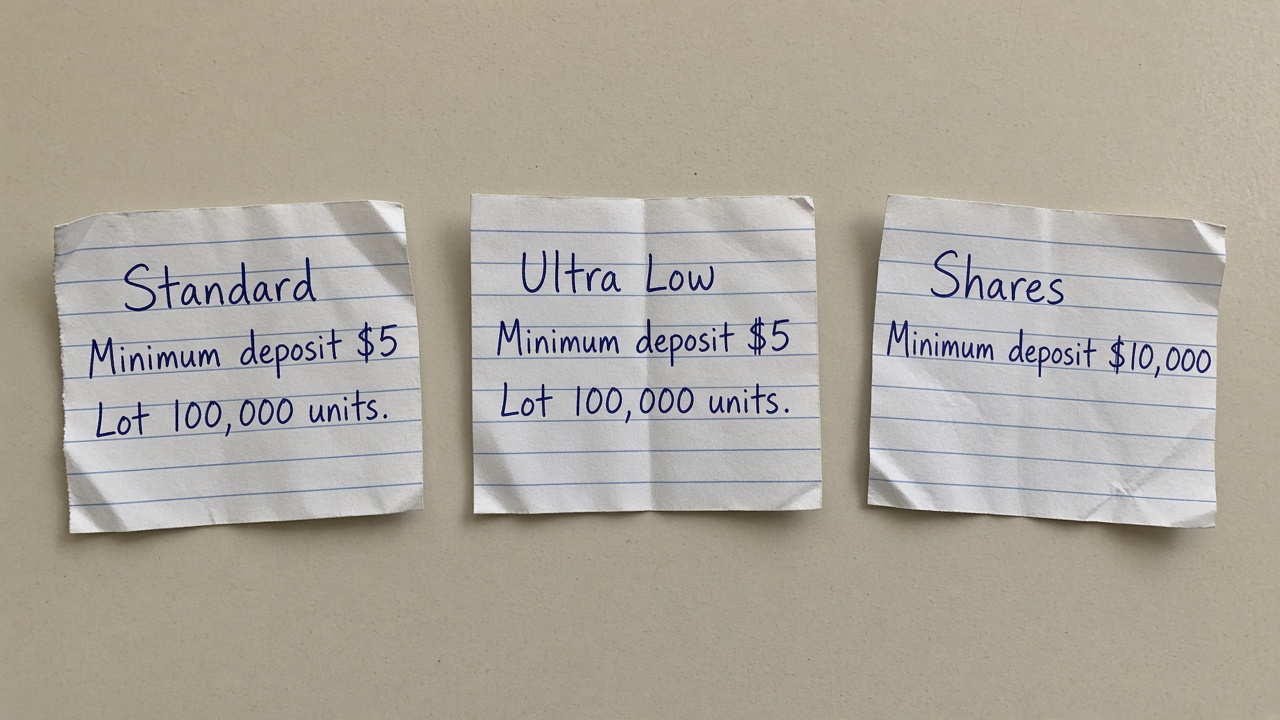
That wording matters more than the account nickname on a marketing page. If the agreement names Trading Point of Financial Instruments Ltd and the account is XM Zero, the examples below are the ones to check against the ticket. If the agreement names another company, stop and use that company's table. Do not paste the USD 7 line onto every page that uses the XM name. The commission section of this paper does not name Ultra Low, Standard, or a shares account. A blog that assigns a commission to one of those names is talking about a different document.
How the USD 7 is calculated
The paper's own arithmetic is:
2 × (3.50 × USD notional ÷ 100,000)
When the base currency is US dollars, one standard lot is usually a notional of USD 100,000, so one lot is USD 7. The paper's first worked case is a buy of 3 lots of USDJPY. The notional is USD 300,000. Then 2 × (3.50 × 300,000 ÷ 100,000) = USD 21. That USD 21 leaves the account at the open, not half now and half at the close.
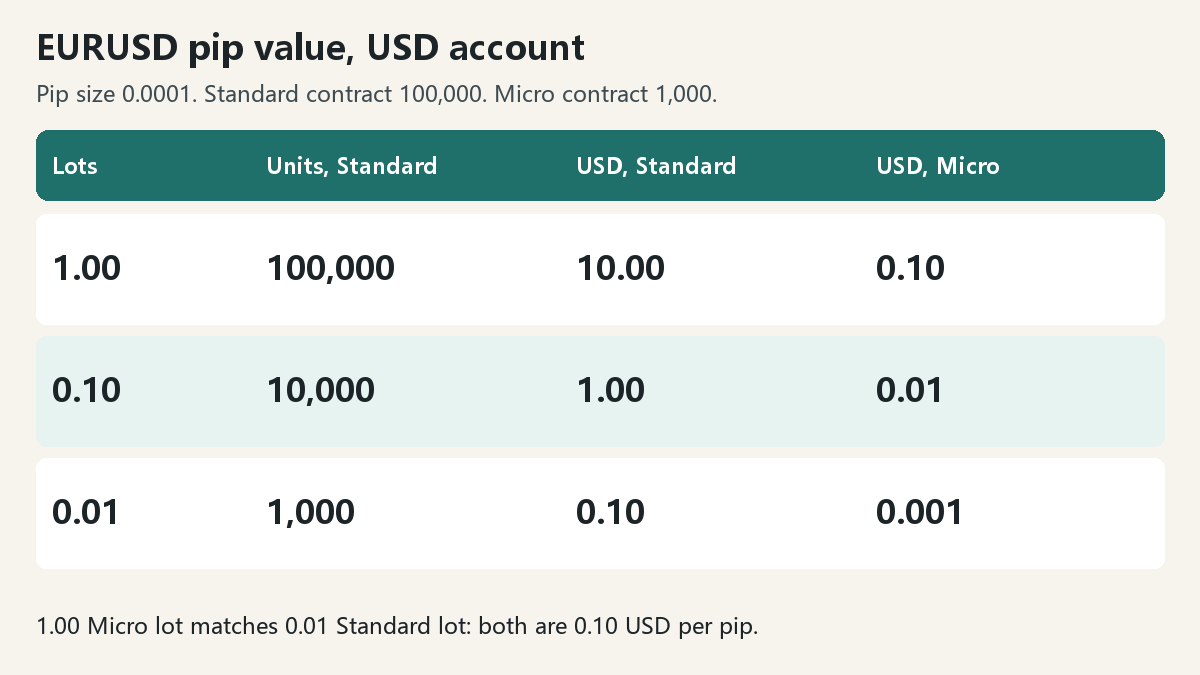
A smaller size uses the same ratio. A 0.10 lot position with a USD notional of 10,000 is 2 × (3.50 × 10,000 ÷ 100,000) = USD 0.70, still taken in full at the open. Read the notional on the ticket. Do not multiply USD 7 by the lot count until you know the notional is in US dollars.
Both sides are taken when the trade opens
Traders often budget USD 3.50 now and another USD 3.50 on the way out. The paper does the opposite. It charges the opening commission and the closing commission together, at the moment the position is opened. Closing the trade later does not add a second USD 3.50 under this rule. The close side has already been taken.
Check the account history on the day the order is filled, not on the day it is closed. If the history shows the full round-turn amount at the open, that matches the paper. If it shows only half, the account may be on a different schedule, or the platform may be labelling spread and commission in separate rows. Match the row name before you treat a missing half as a refund.
EURUSD is not USD 7 per lot
The second example in the paper is a buy of 2 lots of EURUSD at 1.10000. Two lots are 200,000 euro. At that rate the USD notional is 200,000 × 1.10000 = 220,000. The commission is 2 × (3.50 × 220,000 ÷ 100,000) = USD 15.40. It is not 2 × 7.
The same steps on one lot, still at 1.10000, give a notional of USD 110,000 and a commission of USD 7.70. The paper prints the two-lot case. The one-lot figure is the same formula, not a second published example. If the fill is at another price, replace 1.10000 before you multiply. A higher euro price raises the USD notional and the commission. A lower price cuts both.
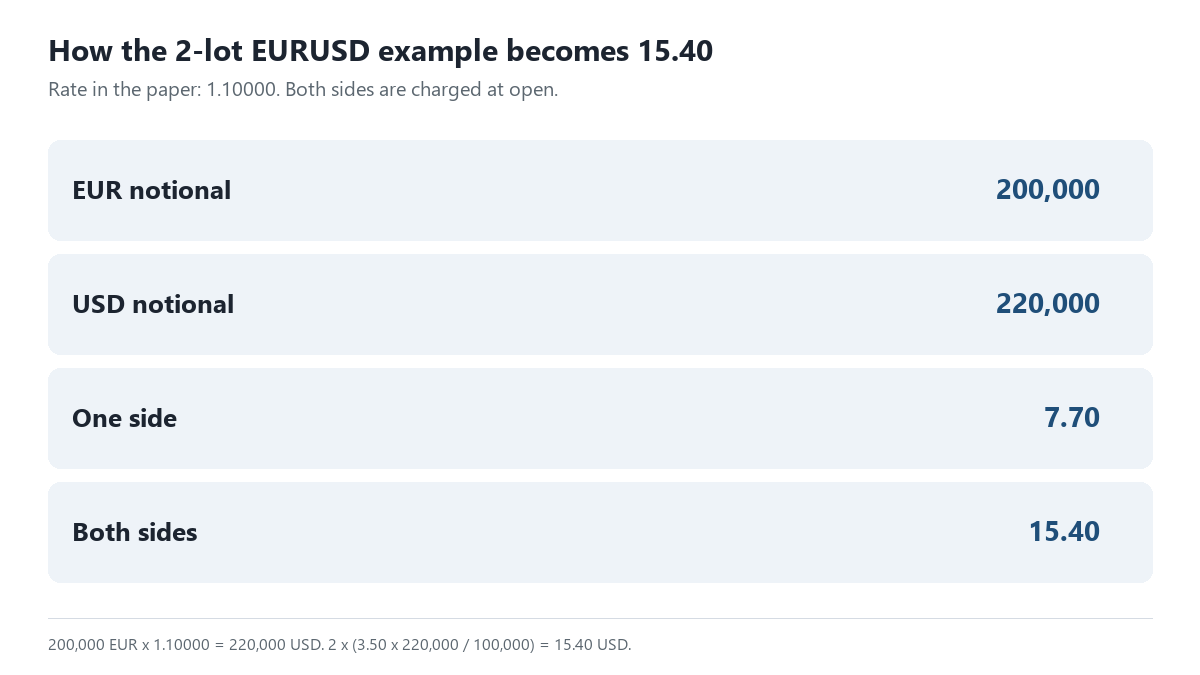
This is why a quote of "USD 7 a lot" fails on euro, sterling, or any base that is not the US dollar. Convert the position to a USD notional first, then apply USD 3.50 per USD 100,000 per side, and remember both sides are taken together.
Spread, swap, and the dormant fee are other lines
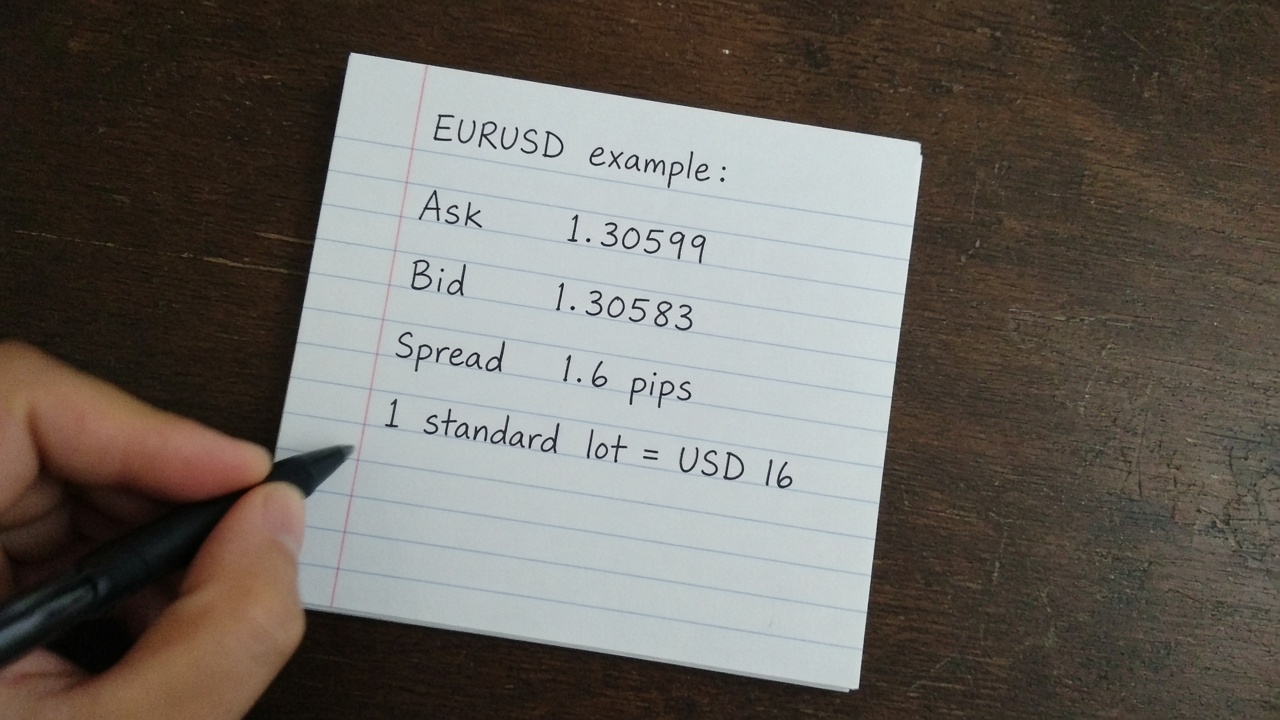
The same paper shows a spread example that is easy to mix into the commission. EURUSD is quoted with an ask of 1.30599 and a bid of 1.30583. The gap is 1.6 pips. On one standard lot the paper values that gap at USD 16. A buy opens on the ask and closes on the bid, so the spread is paid across the round turn. That USD 16 is not inside the USD 7 commission, and it is not the spread you should expect on an XM Zero ticket. It is one example of how a variable spread is turned into money. The pip method, and how to read a live quote, is covered in how XM spreads are checked.
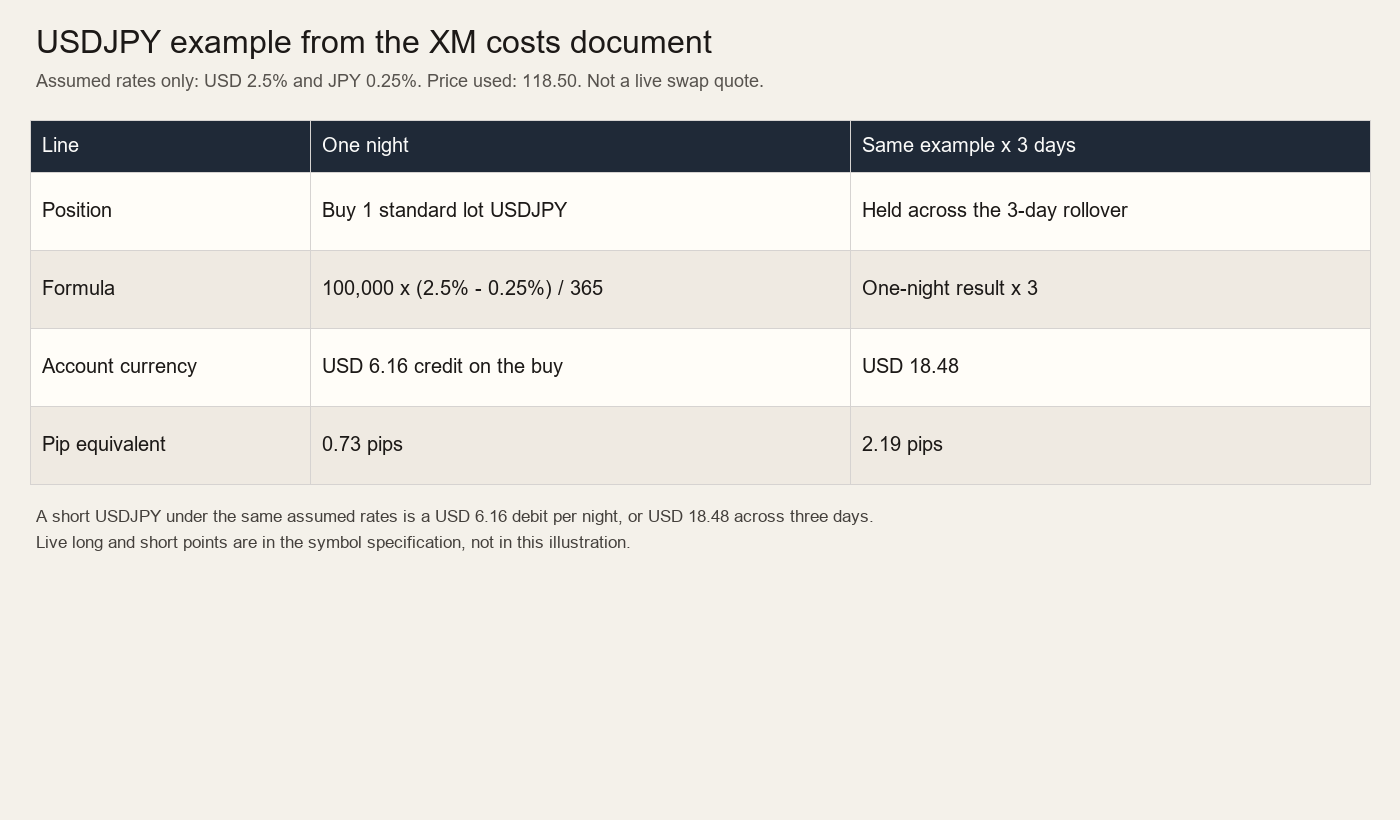
Swap is the overnight financing charge. In this paper the rollover point is 22:00 GMT. A position that is open at 21:59 can be charged that night. A position opened at 22:01 waits until the next rollover. There is no Saturday or Sunday rollover, but Wednesday carries three days for FX and precious metals. Cash indices, cash energies, and stocks use Friday for the three-day charge. Swap can be a debit or a credit. It is not a commission, and the paper's dollar illustration uses assumed interest rates. Use the swap shown on the symbol for the day you hold the trade.
The dormant fee is an account cost for inactivity. After 90 calendar days with no trading, no withdrawal, and no deposit, the paper charges USD 10 a month, or the whole free balance if that balance is under USD 10. A free balance of zero is not charged. An account that stays at zero can be archived after 90 days. This fee does not scale with lots, and it is not evidence that a Zero account "has no costs."
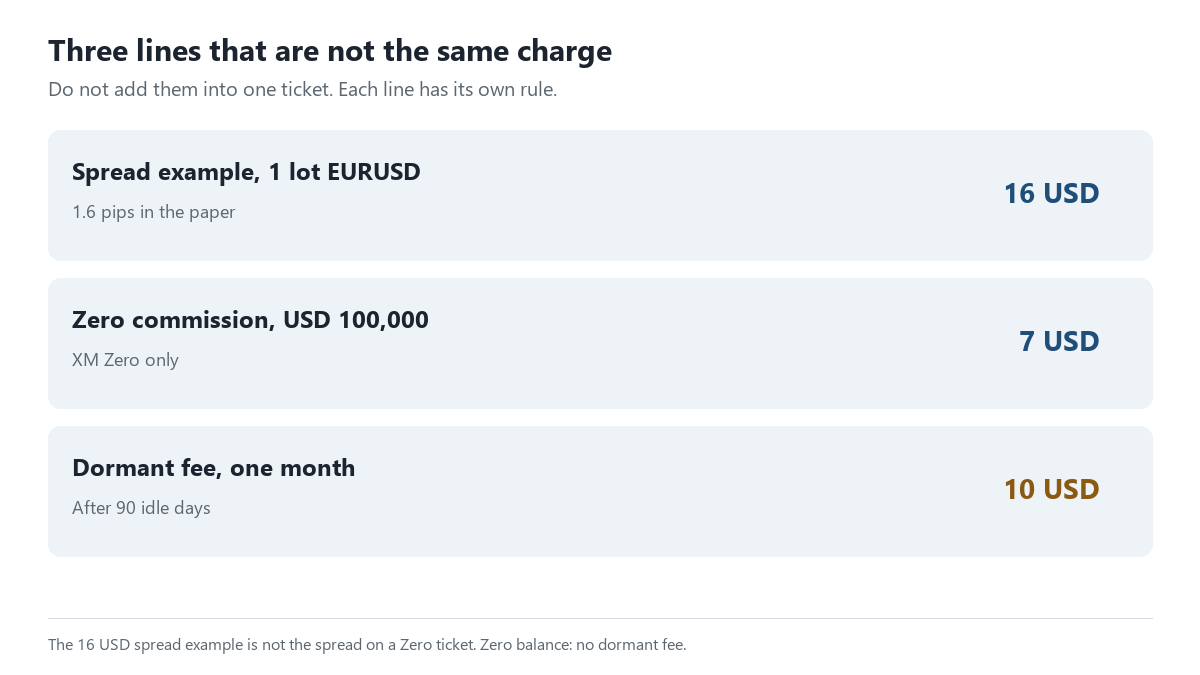
Do not add 16, 7, and 10 into one ticket. They answer three questions: what a 1.6 pip illustration costs, what Zero commission costs on USD 100,000, and what an idle account can be charged after 90 days. A live Zero trade still needs its own spread and its own swap read off the symbol.
What a rebate changes
Cashback on xmforexcashback.in is calculated after the broker has already applied its own charges. On an XM Zero account that follows this paper, the commission debit is visible at the open. A later rebate does not rewrite that row. It can reduce the net cost only when the rebate terms say the trade qualifies and the amount has been confirmed.
Start with which accounts can be attached for a rebate, then use the net cost per lot method so commission, spread, and cashback stay in separate columns. The forex rebate calculator is there for the arithmetic once you have a rate. The XM rebates card is a screening list. It is not this commission schedule, and a leverage or deposit line on that card is not a cost from the paper.
Opening the account on the rebate path, and checking whether cashback can be attached, stays in that teaching on xmforexcashback.in. The commission table still comes from the company on the agreement. A rebate is not a statement that the account is safer, and it is not trading profit.
What an India resident should separate from the arithmetic
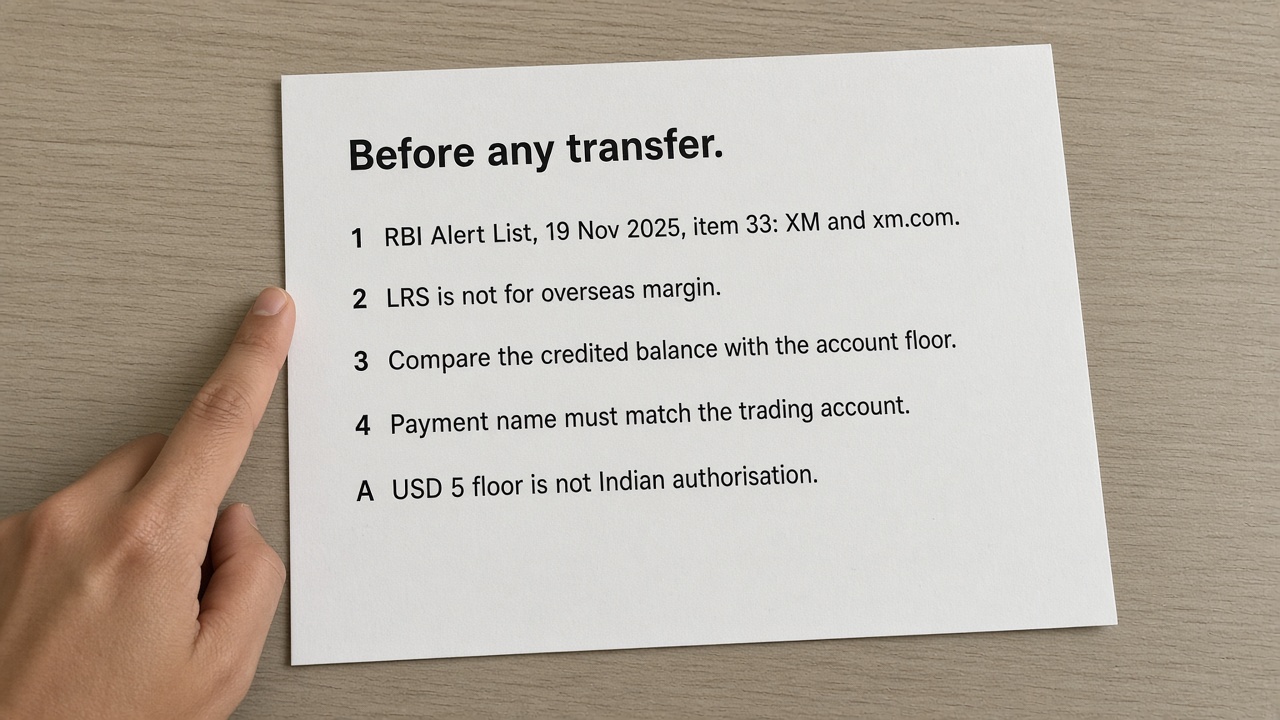
The USD 7 formula does not say an India resident may open or fund the account. The Reserve Bank of India says residents may deal in foreign exchange with authorised persons, and only for permitted purposes. Electronic platforms for forex trading sit with RBI-authorised venues or the recognised exchanges. The same authority's liberalised remittance answers say a resident cannot remit margins or margin calls to overseas exchanges or overseas counterparties, and cannot remit funds to trade foreign exchange abroad. Those limits are in the RBI foreign-exchange FAQ and the liberalised remittance FAQ. How that boundary applies to this brand is set out in whether XM is allowed in India. This page stops at the cost arithmetic.
Read one ticket against the agreement
Read the company name on the client agreement before you use any commission number.
If that company is Trading Point of Financial Instruments Ltd and the account is XM Zero, convert the position to a USD notional and apply 2 × (3.50 × notional ÷ 100,000). Expect the full amount at the open.
If the company or the account type is different, do not force the USD 7 schedule onto the ticket.
Read the spread from the live quote and the swap from the symbol. Keep the dormant fee, if the account has been idle for 90 days, off the per-trade sum.
If the account was opened on the rebate path here, confirm eligibility and then subtract only a confirmed cashback from the net cost.
A ticket that shows USD 15.40 at the open on 2 lots of EURUSD matches the paper only when the USD notional was about 220,000, the rate behind that notional was 1.10000, and the account is XM Zero at that company. Change the rate and the result changes. A commission row on a different account type is a reason to re-read the agreement, not a reason to assume the paper forgot a line.
FAQ
Does every account pay an XM commission?
No. In the costs paper of Trading Point of Financial Instruments Ltd, the separate commission is written for XM Zero only. The rate is USD 7 per USD 100,000, taken in full when the trade opens. Other account names in that paper are not given this line. If your agreement names another company, that company's schedule is the one to use.
When is the Zero commission taken?
At the open. The paper splits the round turn into USD 3.50 to open and USD 3.50 to close, then deducts both amounts when the position is opened. You do not wait for the close to pay the second half, and closing the trade does not add another USD 3.50 under this rule. Look at the account history on the fill date.
Is USD 7 the commission on every one-lot forex trade?
Only when the USD notional is 100,000. One standard lot of a USD pair such as USDJPY fits that case, so the paper's rate is USD 7. One lot of EURUSD at 1.10000 is a notional of USD 110,000, and the same formula gives USD 7.70. Two lots at that rate are the paper's printed example: USD 15.40.
Why is the 2-lot EURUSD example 15.40 instead of 14?
Because the commission follows the USD value of the position, not a flat USD 7 per lot. Two lots are 200,000 euro. At 1.10000 that is USD 220,000. Then 2 × (3.50 × 220,000 ÷ 100,000) = 15.40. A different fill price produces a different USD notional and a different commission.
Is the spread already inside the commission?
No. The paper's spread illustration is a separate 1.6 pip gap, valued at USD 16 on one standard lot of EURUSD using the quotes 1.30599 and 1.30583. That figure is not added into the USD 7, and it is not the spread on a Zero ticket. Read the live bid and ask on your symbol, then keep that cost beside the commission rather than inside it.
Is the dormant fee a kind of commission?
No. It is a monthly charge for inactivity. After 90 calendar days with no trade, withdrawal, or deposit, the paper charges USD 10, or the full free balance if the free balance is under USD 10. A zero free balance is not charged. The fee does not depend on lot size, so it never belongs in the per-trade commission formula.
Does a cashback rebate cancel the commission debit?
It does not delete the row the broker posted at the open. A rebate on xmforexcashback.in can lower the net cost later, and only for trades the rebate terms actually cover, after the amount is confirmed. Check eligibility first, then keep commission, spread, and cashback in separate columns. The rebate is not a safety claim and it is not profit.
Which company does this USD 7 schedule belong to?
Trading Point of Financial Instruments Ltd, the company named on the costs and charges paper, under CySEC licence 120/10. Use the schedule when that name is the company on your client agreement and the account is XM Zero. A different legal name on the agreement means a different table, even if the brand on the website looks the same.
What if the agreement names a different company?
Use that company's charges. Public pages under the same brand can show other average spreads and other account names. Those figures are not a second copy of this Zero commission. Match the legal name first, then read the commission, spread, and swap that belong to the account you actually hold.
Does this arithmetic mean a resident of India can fund the account?
No. The Reserve Bank of India limits resident forex dealings to authorised persons and permitted purposes, and its remittance rules do not allow margin sent to an overseas exchange or counterparty. The commission formula is a way to read a ticket. It is not approval to open or fund an account. The India permission page on this site is the place for that boundary.
Where should the swap be read?
On the symbol, for the day you hold the position. This paper uses 22:00 GMT as the rollover point and a triple charge on Wednesday for FX and precious metals. It does not publish one swap number you can reuse every night. An assumed interest example in the paper is not tonight's rate. Keep swap out of the commission column.
What happens to a zero balance after 90 idle days?
Under this paper, a free balance of zero is not charged the USD 10 dormant fee. The account can still be archived after 90 days with no trading, withdrawal, or deposit. A small balance under USD 10 can be taken in full. That is an inactivity rule for this company, not a commission on a trade you did not place.