
 Practical trading resource
Forex Margin Calculator
With our convenient Forex Margin Calculator, you can determine the exact margin required to open a position based on the leverage provided by your broker.
Trading calculation workspace
Enter your planning values to organise a clear risk estimate before placing a trade.
Planning estimate
About Forex Margin Calculator

Use this handy forex and crypto margin calculator tool to accurately calculate the required capital needed to open or add to a trading position, based on your lot size and the leverage offered by your broker.
What is Leverage and Margin in Trading?
Leverage allows traders to control a larger position using less capital (margin), thereby significantly amplifying both potential profits and losses. Trading with leverage is also commonly referred to as margin trading.
Leverage magnifies both prospective gains and losses. For example, buying EUR/USD at 1.0000 without leverage would require the price to drop all the way to zero for a total loss, or rise to 2.0000 to double your investment. If you trade using 100:1 leverage, a price movement of just 1/100th of that distance will generate the exact same profit or loss.
Margin is the capital a trader must set aside to open a new position. It is not a fee or a cost, and it is released once the trade is closed. Its primary purpose is to protect the broker against potential losses. When losses reduce a trader's margin below a pre-set stop-out percentage, the broker will automatically close one or all open positions. Before closing positions, the broker may or may not issue a margin call warning.
How Leverage Works
With 100:1 leverage, a trader can open a position 100 times larger than without leverage. For example, if opening a 0.01 lot EUR/USD position costs $1,000 without leverage, and the broker offers 100:1 leverage, the trader only needs $10 as margin. Naturally, traders can also use lower leverage, such as 30:1 or 5:1, or trade without leverage entirely.
Note: Higher leverage ratios entail higher risk. Most professional traders use lower leverage ratios—up to 5:1 max—or no leverage at all, while risking a small percentage per trade (typically no more than 2% of account equity).
How to Use This Forex Margin Calculator
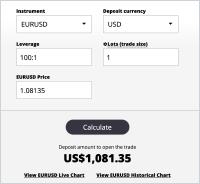
Instrument: In this field, traders can select from multiple forex crosses (including major and minor pairs), popular cryptocurrencies (ADA, BTC, DOGE, ETH, LTC, Stellar, Ripple, etc.), as well as commodities (such as Gold, Silver, and Oil). In this example, we will select EUR/USD.
Deposit Currency: Margin requirements for forex pairs and other instruments vary based on live market quotes. By selecting your deposit currency, you can accurately view the required margin to open a position in your chosen currency (from AUD to ZAR). In this example, we will select GBP as the deposit currency.
Leverage: In this field, enter your leverage ratio. This can be the current leverage provided by your broker or any ratio from 1:1 up to 6000:1 to simulate the required margin. In this example, we will select 30:1 leverage.
Lots (Trade Size): Simply enter the trade size in lots. Remember, in forex trading, 1 standard lot equals 100,000 currency units, though lot sizes for non-forex instruments may vary. Therefore, you can also toggle between "Lots" and "Units" for calculation in this field. In this example, we will use a trade size of 0.10.
Click the "Calculate" Button: The tool will automatically calculate the margin required to open the position based on the parameters entered above.
Example Result: Using all the input data above, the leverage and margin calculator shows that to open a 0.10 lot EUR/USD long or short position with 30:1 leverage at a current EUR/GBP exchange rate of 0.90367, a required margin of £301.22 is needed.
The leverage and margin calculator can also be used to find pairs with lower margin requirements. Using the same parameters (30:1 leverage and a 0.10 lot trade size), if we select AUD/USD, we can see that the required margin is significantly lower at just £186.89.
FAQ
What is Forex Margin?
Forex margin is the set-aside funds required by a broker to open a trading position. It is not an extra fee, but rather a security deposit used to cover trading risks; once the position is closed, these funds are released back to your account balance. The required margin depends on the trading instrument, trade size (lots), and the leverage ratio used.
How does leverage affect the required margin?
The higher the leverage, the less margin is required to open a position of the same size; conversely, lower leverage requires more margin. For example, at 100:1 leverage, opening 1 standard lot of EUR/USD requires a margin equal to roughly 1% of the contract's nominal value; at 30:1 leverage, it requires approximately 3.33%. Note that higher leverage amplifies both potential profits and losses, increasing overall risk.
How does this leverage and margin calculator calculate margin?
The calculator retrieves real-time or near-real-time market prices based on your selected instrument, account deposit currency, leverage ratio, and lot size. It first calculates the total nominal value of the position and then calculates the required margin based on your leverage ratio. Simply fill in the parameters and click the "Calculate" button to get the exact margin required to open your trade.
Why is there a slight difference between the calculation results and what is displayed on my broker's platform?
Common reasons for discrepancies include:
Different brokers have different contract specifications and minimum lot size settings;
Some brokers temporarily increase margin requirements during high volatility or ahead of weekends;
Slight differences in price feeds, spreads, and currency conversion methods.
Therefore, the figures provided by this tool are estimates based on standard contracts and are for reference only. Please refer to your broker's trading platform for the actual margin.
Can I use this tool to compare margin requirements across different currency pairs or instruments?
Yes. You can select different forex currency pairs, indices, commodities, or cryptocurrencies under the "Instrument" field while keeping the leverage and lot size settings constant. The calculator will display the required margin for each instrument, allowing you to easily compare which trading instruments require less margin and better suit your current account size and risk tolerance.
What leverage level is safe for me to use?
There is no single "best leverage" that works for everyone; however, most professional traders choose conservative leverage and strictly manage their risk per trade:
A common practice is to use an effective leverage of 5:1, 10:1, or lower;
Cap the maximum loss per trade at 1%–2% of account funds;
Reduce position sizes and leverage during major economic releases or high volatility periods.
We recommend using this margin calculator to simulate various parameter combinations first to find a leverage level that meets your trading strategy while fitting your risk tolerance.
Can trading on margin lead to a negative account balance?
Under extreme market conditions, such as sudden price gaps or severe volatility, it is theoretically possible for losses to exceed your account balance, resulting in a negative balance. However, many regulated brokers offer "Negative Balance Protection," limiting maximum losses to your account equity.
You can use this tool to check the required margin for each trade in advance and combine it with proper position management and stop-loss orders to minimize extreme risks. Please refer to your broker's terms and conditions for specific protection mechanisms.
Related trading tools
Explore more resources for risk, margin and trade planning.
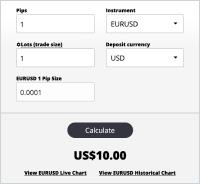
Forex Spread Calculator
The Forex Spread Calculator is an essential tool for forex traders, helping you accurately calculate spreads across different currency pairs.
Use this tool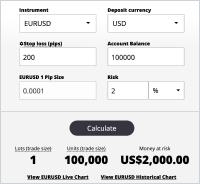
Position Size and Risk Calculator
The Forex position size and risk calculator is an indispensable tool in forex trading.
Use this tool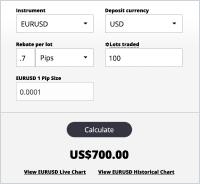
Forex Cashback Calculator
Forex cashback and rebate calculators are essential tools for forex traders, helping you maximize your trading profits.
Use this tool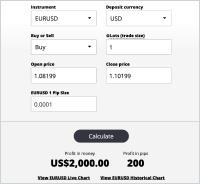
Forex Profit Calculator
The Profit and Cashback Calculator is a powerful tool for forex traders, helping you accurately calculate potential profits and cashback for your trades.
Use this tool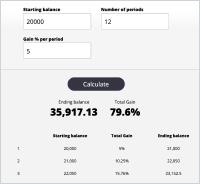
Forex Compounding Calculator
The Forex Compounding Calculator is an essential tool for forex traders, helping you project and calculate the impact of compounding on your trading account.
Use this tool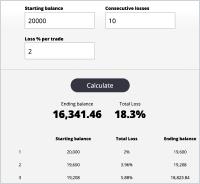
Drawdown Calculator
Use our Forex Drawdown Calculator to accurately calculate how a series of losing trades impacts your trading account balance.
Use this tool