
 Practical trading resource
Margin Call Risk Calculator
Use our convenient Forex Risk of Ruin Calculator to accurately calculate the probability of maximum loss based on your win/loss percentage.
Trading calculation workspace
Enter your planning values to organise a clear risk estimate before placing a trade.
Planning estimate
About Margin Call Risk Calculator

Use our Forex Risk of Ruin Calculator to accurately estimate the probability of your account experiencing a peak-to-trough drawdown or complete loss over a given number of trades, based on your trading system's win rate, risk-reward ratio, and risk percentage per trade, helping you evaluate the overall robustness of your strategy.
What is Risk of Ruin (RoR)?
Risk of Ruin (RoR) is a mathematical model used to calculate the probability of losing all your trading capital or reaching a specified maximum drawdown, based on your trading system's win rate, risk-reward ratio, and risk percentage per trade.
For example, if a trading strategy has a win rate of 30%, an average payoff ratio of 2, and a risk per trade of 2%, you can enter these metrics into the Risk of Ruin Calculator to assess the system's overall robustness. This calculator is equally useful for managing the risk of ruin and maximum drawdown for your trading strategies.
Through these calculations, traders can understand the likelihood of a specific trading strategy leading to severe account drawdown or total loss over time. Simply enter your strategy's historical performance metrics to quickly calculate the probabilities across different drawdown levels.
How to Use the Forex Risk of Ruin Calculator
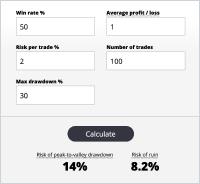
1. Win Rate %
Enter the overall win rate of your trading system here. For example, if your current strategy has a win rate of 30%, enter 30 in the "Win Rate %" field.
2. Average Win / Loss
Enter the ratio of your average profit to average loss in this field (the win/loss ratio). For example, if each winning trade earns an average of 2 units while each losing trade loses an average of 1 unit, enter 2.
3. Risk Per Trade %
We generally recommend that professional traders risk no more than 2% of their account equity per trade. Enter the percentage of risk you plan to take on each trade in this field, such as 2%. Lower risk per trade allows your account to survive longer in the market and provides an opportunity to recover from adverse market moves.
4. Number of Trades
If you are testing a trading strategy, enter the total number of trades you plan to test; if you are evaluating the performance of a current strategy, enter the total number of executed trades. For example, if you want to evaluate risk over the next 100 trades, enter 100 in this field.
5. Maximum Drawdown %
Enter the maximum drawdown level you wish to evaluate (expressed as a percentage). If you are testing a new strategy, enter the maximum tolerable drawdown, such as 30%; if you are evaluating historical performance, enter the maximum drawdown that the strategy has experienced in the past.
After filling in all fields, click the "Calculate" button to generate the results.
Understanding the Results
The calculator will first display the "Probability of reaching the specified maximum drawdown". In the example, if this value is 21.1%, it means that within the set number of trades, the probability of the account experiencing a peak-to-trough drawdown of at least 30% is approximately 21.1%. This is commonly used as a metric to measure one of the worst-case scenarios your strategy might face.
The second result is the "Risk of Ruin", which represents the probability of the account drawing down to a specific percentage of the starting capital (for instance, 30% remaining capital). If the result is 13.7%, it indicates that over the given number of trades, the probability of account equity falling to or below that level is roughly 13.7%.
Please note that the Risk of Ruin calculator relies on extensive Monte Carlo simulations (e.g., 100,000 iterations). Consequently, results may vary slightly between calculations, representing statistical estimates.
By adjusting the input parameters (such as trade count, risk per trade, and maximum drawdown), you can simulate potential outcomes across different risk management models to fine-tune your trading strategy's risk parameters.
To further evaluate the impact of consecutive losing streaks on your account, you can also use our Forex Drawdown Calculator alongside this tool to gain a more comprehensive overview of your overall trading risk.
Frequently Asked Questions (FAQ)
What is an acceptable level for Risk of Ruin?
Generally, a robust long-term trading system maintains a very low probability of ruin over a given sample of trades. Many professional traders target a Risk of Ruin below 5%, or even under 1%. The ideal threshold depends on your personal risk tolerance, capital size, and trading strategy.
Does a high win rate guarantee a low Risk of Ruin?
Not necessarily. Risk of Ruin is determined by the combination of win rate, win/loss ratio, and risk per trade. Even with a high win rate, if your risk per trade is excessively high or your losses significantly outweigh your gains, you can still experience a high Risk of Ruin. Therefore, all factors must be evaluated together using the calculator.
Can the calculator's simulation results represent actual trading results?
The risk of ruin calculator is based on historical statistics and Monte Carlo simulations, providing probability estimates based strictly on current underlying assumptions, which cannot guarantee future outcomes. Real trading is also influenced by market condition changes, slippage, execution errors, and psychological factors. Therefore, the results should be treated as a risk reference rather than a deterministic forecast.
How many historical trades should I use to calculate the risk of ruin?
The larger the sample size, the more reliable the statistical results tend to be. We recommend using at least several dozen to a few hundred historical trades, especially for medium- to long-term strategies. If the sample size is too small, the calculated win rate and risk-to-reward ratio may deviate significantly from the strategy's true performance, leading to an inaccurate risk of ruin assessment.
Related trading tools
Explore more resources for risk, margin and trade planning.
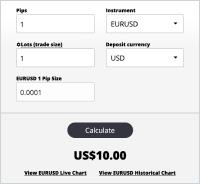
Forex Spread Calculator
The Forex Spread Calculator is an essential tool for forex traders, helping you accurately calculate spreads across different currency pairs.
Use this tool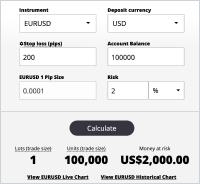
Position Size and Risk Calculator
The Forex position size and risk calculator is an indispensable tool in forex trading.
Use this tool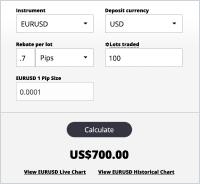
Forex Cashback Calculator
Forex cashback and rebate calculators are essential tools for forex traders, helping you maximize your trading profits.
Use this tool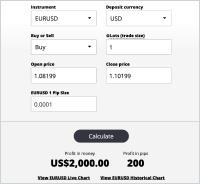
Forex Profit Calculator
The Profit and Cashback Calculator is a powerful tool for forex traders, helping you accurately calculate potential profits and cashback for your trades.
Use this tool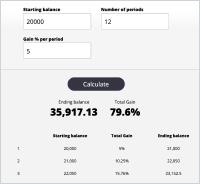
Forex Compounding Calculator
The Forex Compounding Calculator is an essential tool for forex traders, helping you project and calculate the impact of compounding on your trading account.
Use this tool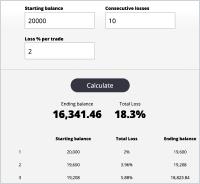
Drawdown Calculator
Use our Forex Drawdown Calculator to accurately calculate how a series of losing trades impacts your trading account balance.
Use this tool