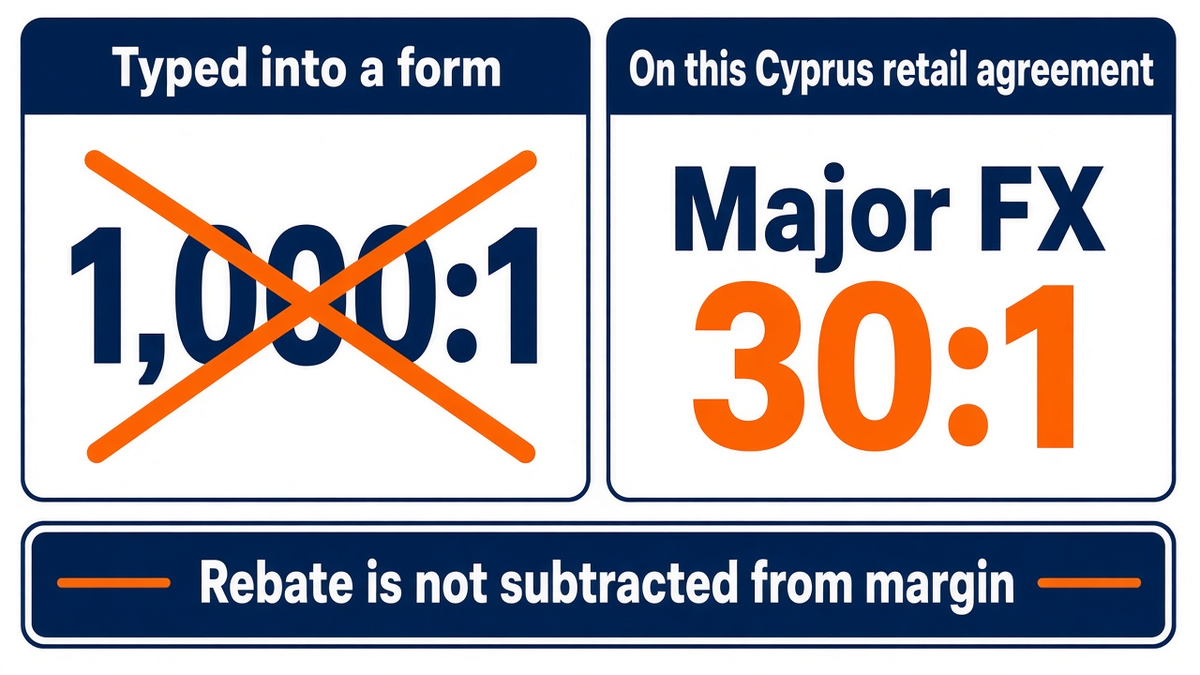
An XM margin calculator does one job: lots × contract size × opening price, then divide by the leverage on the agreement. On a standard forex symbol the contract size is 100,000 units of the base currency. Doubling the lot doubles the margin. Doubling the leverage cuts the margin in half, but only when that leverage is actually on the account. A box that accepts 1,000:1 is running arithmetic. It is not an offer.
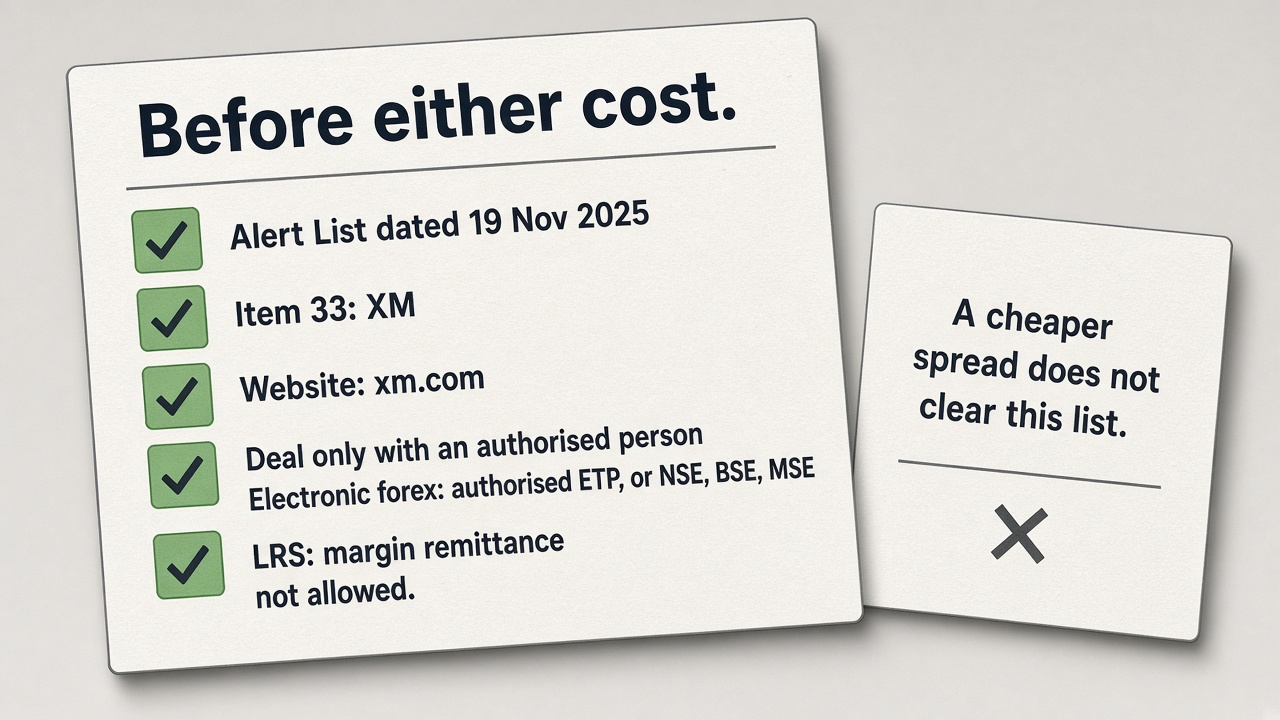
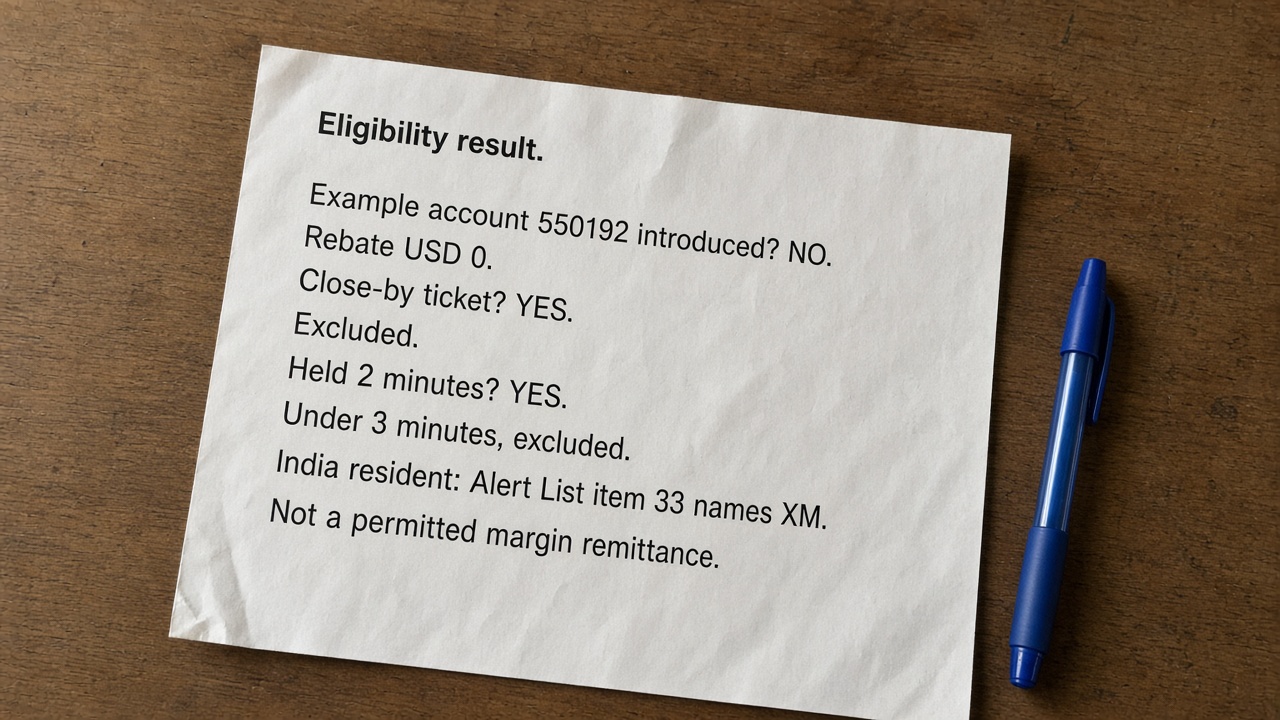
For a retail client of Trading Point of Financial Instruments Ltd, major FX stops at 30:1. The firm’s risk disclosure labels that cap 3.33%. Divide by 30 and multiply by 3.33% do not land on the same cent. If you live in India, the resulting dollar figure is still not permission to send margin abroad. The Reserve Bank of India release of 3 February 2022 says remittances for margins to overseas exchanges or overseas counterparties are not permitted under the Liberalised Remittance Scheme. Who may deal with a resident, and whether a name sits on the Alert List, is covered in the India check on this site. A rebate does not change the margin or that check.
What an XM margin calculator multiplies
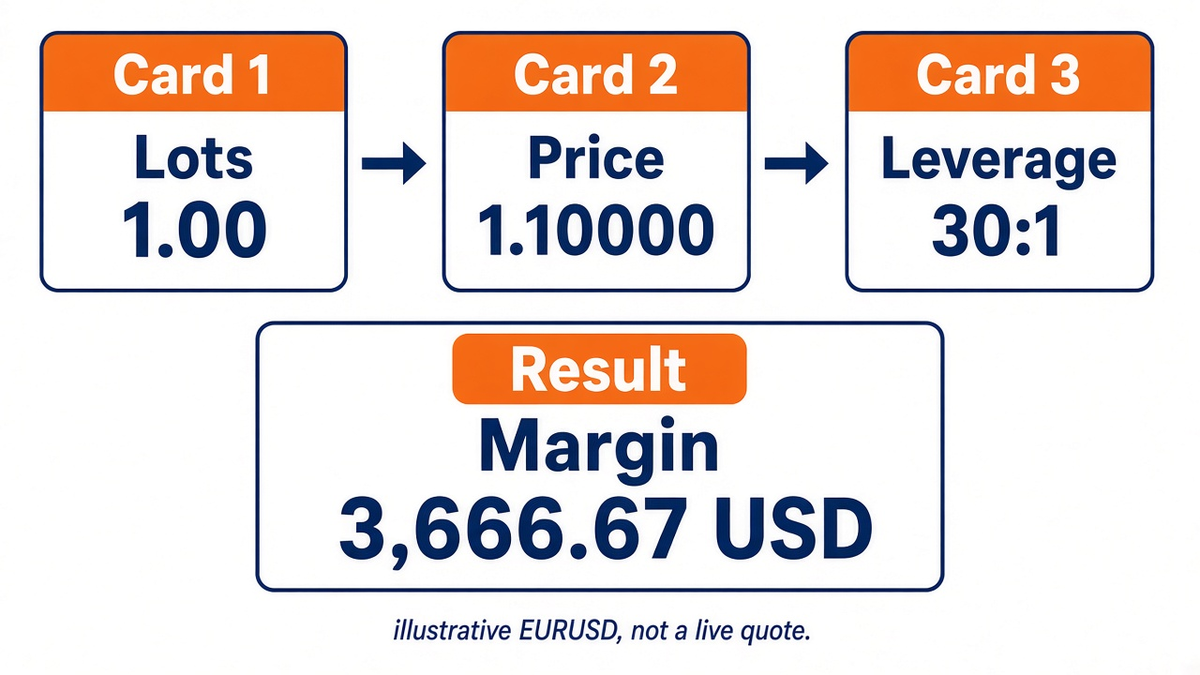
Write the position in account money first, then apply leverage. For EURUSD the price is US dollars per euro, so a USD account can stay in dollars:
Notional = lots × contract size × price
Margin = notional ÷ leverage
At a price of 1.10000, one standard lot is 100,000 × 1.10000 = 110,000 dollars of exposure. At 30:1 the margin is 110,000 ÷ 30 = 3,666.67 dollars. That price is a round teaching number, not a live XM quote. The disclosure’s own illustration uses EURUSD at 1.28390, a notional of 128,390 dollars, and about 4,275 dollars of margin at 3.33%. Keep that pair of figures inside the document they came from. Do not paste 1.28390 into a ticket that shows a different price.
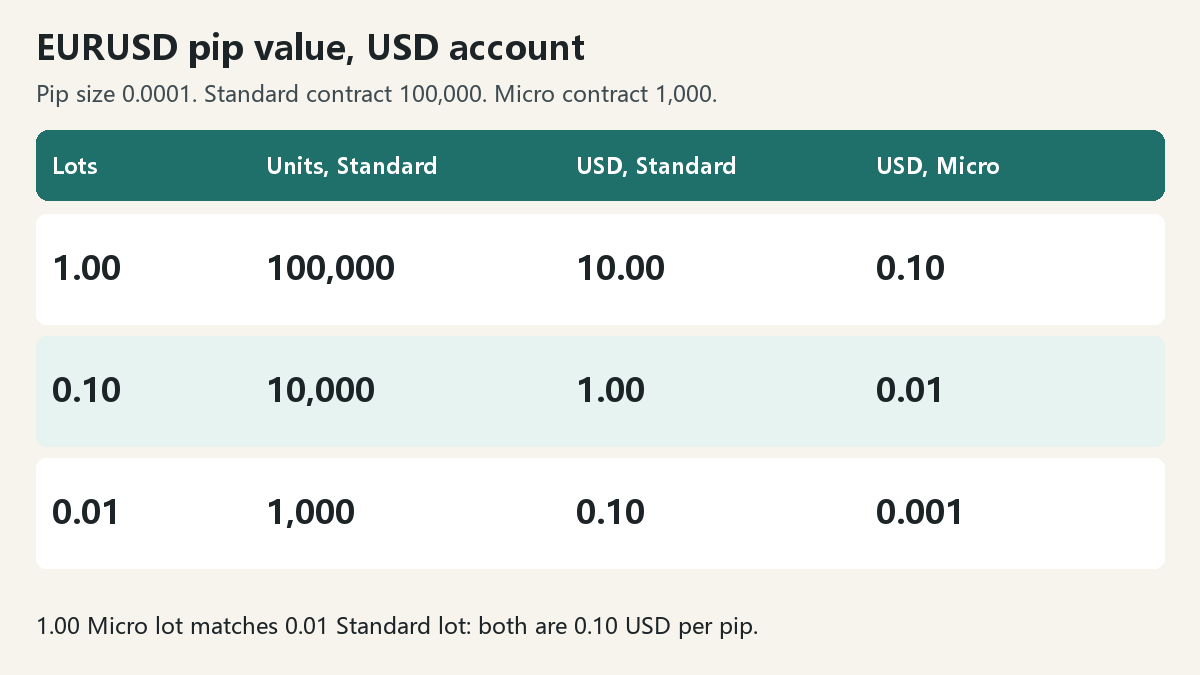
Contract size is not always 100,000. Open the symbol specification and read the contract size on that row. A micro or cent-style setting can make “1 lot” a much smaller unit. What 1 standard lot means on each account menu is in the lot-size note. If the account currency is not the quote currency, the platform converts the margin. The calculator cannot guess that rate for you.
Lot size moves margin in a straight line
Leverage stays put and the lot changes: margin changes by the same factor. From the 1.10000 example at 30:1:
1.00 lot sets aside 3,666.67 dollars.
0.10 lot sets aside 366.67 dollars.
0.01 lot sets aside 36.67 dollars.
Two separate 0.10 positions on the same symbol need the same margin as one 0.20 position, before the platform applies any volume limit or a different margin rate on a larger size. Hedged long and short tickets are not free of margin until the agreement says they are. Read the symbol row rather than assuming the two sides cancel.
Leverage only counts inside the agreement cap
The disclosure names the company: Trading Point of Financial Instruments Ltd, Cyprus company HE 251334, CySEC licence 120/10, trading as XM.com, at Richardou and Verengarias 12, Araouzos Castle Court, 3rd Floor, 3042 Limassol. For retail clients of this company the fixed leverage runs from 2:1 to 30:1, in bands dated from 1 August 2018:
Major FX, pairs made from any two of USD, EUR, JPY, GBP, CAD, and CHF: 3.33%, which the document calls 30:1.
Other FX, and gold: 5%, or 20:1.
Major indices listed in that table: 5%, or 20:1.
Other commodities: 10%, or 10:1.
Shares and share ETFs: 20%, or 5:1.
Crypto indices and ETFs: 50%, or 2:1.
EURUSD is major FX on that list, so a retail account at this company does not get to post the 1,100 dollars that 110,000 ÷ 100 would imply. Gold does not get the 30:1 line either. Another company in the wider brand can print a different maximum. Match the legal name on the agreement before you reuse this table. Account menus and how they differ are in the account-type comparison.
The label 3.33% is a rounded way of writing 1 ÷ 30, which is 3.333…%. On the disclosure’s own 128,390-dollar example, 128,390 ÷ 30 is 4,279.67 dollars, while 128,390 × 3.33% is about 4,275 dollars. Same position, two labels, a few dollars apart. Use divide-by-leverage when the agreement states a ratio, and use the stated percent when the agreement states a percent. Do not mix them and then treat the gap as a platform error.
One illustrative ticket at 1.10000
USD account, EURUSD, contract size 100,000, price 1.10000, leverage 30:1. Not a quote, not a required deposit, and not a promise that this company will fill the order.
| Lots | Notional | Margin at 30:1 | Margin at 3.33% |
|---|---|---|---|
| 1.00 | 110,000 USD | 3,666.67 USD | 3,663.00 USD |
| 0.10 | 11,000 USD | 366.67 USD | 366.30 USD |
| 0.01 | 1,100 USD | 36.67 USD | 36.63 USD |
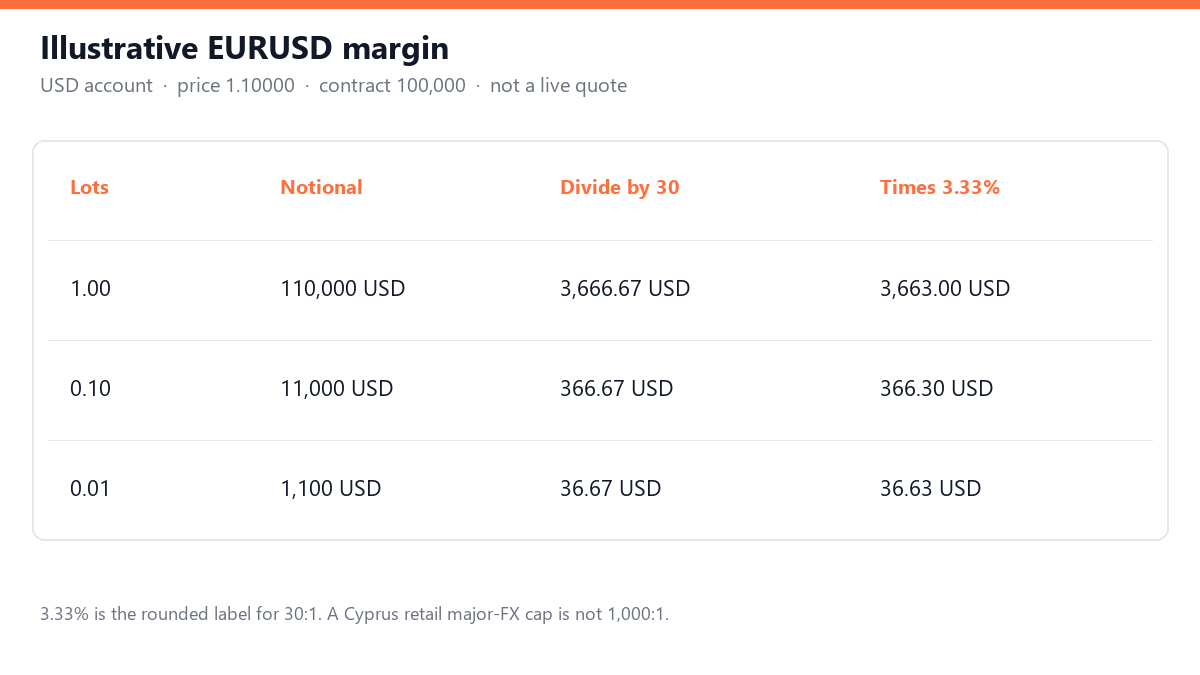
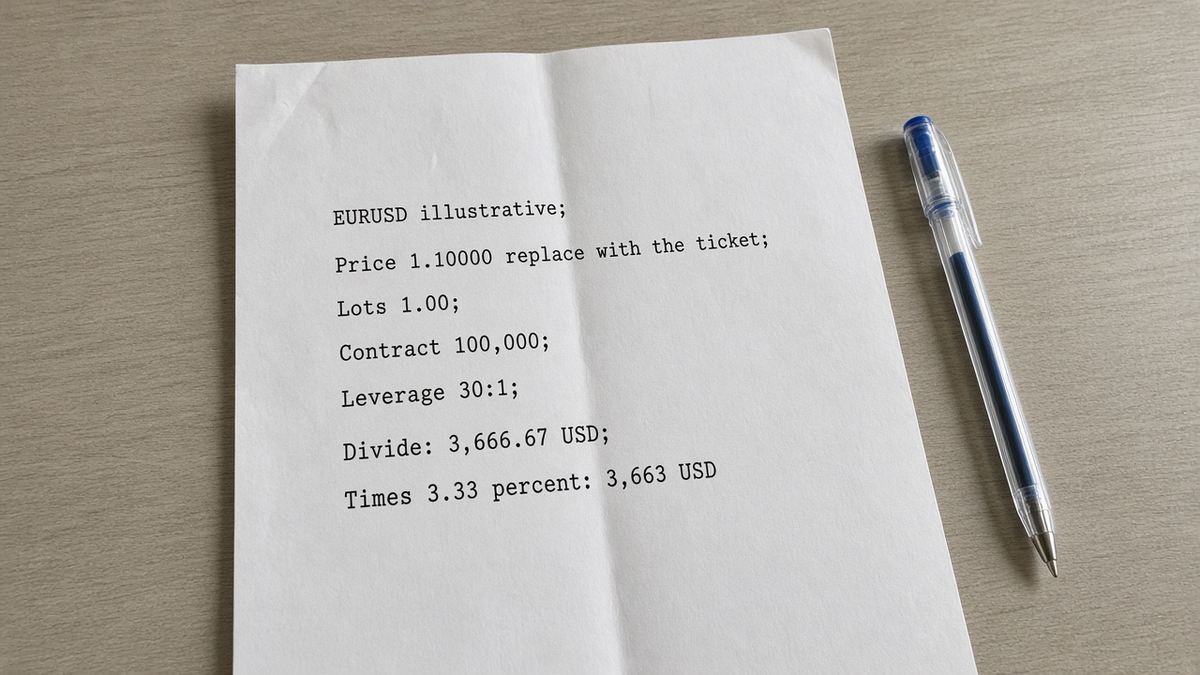
Run the same inputs in the margin calculator after you replace 1.10000 with the price on the ticket and replace 100,000 with the contract size on the symbol. If the tool’s result matches neither column, the leverage or the contract size you typed is not the one on the agreement.
Margin held is not the most you can lose
The disclosure says you post margin to open the trade, and that margin depends on the instrument, the leverage, and the position value. If the margin level falls below the minimum the company sets, it may issue a margin call. You then add funds or close positions. If the account reaches the stop-out level the company has set, positions can be closed at the current price, starting with the largest loss. On this document the company also says losses will not exceed the account balance, because it offers negative-balance protection, and that it can raise margin requirements, including at short notice in abnormal markets.
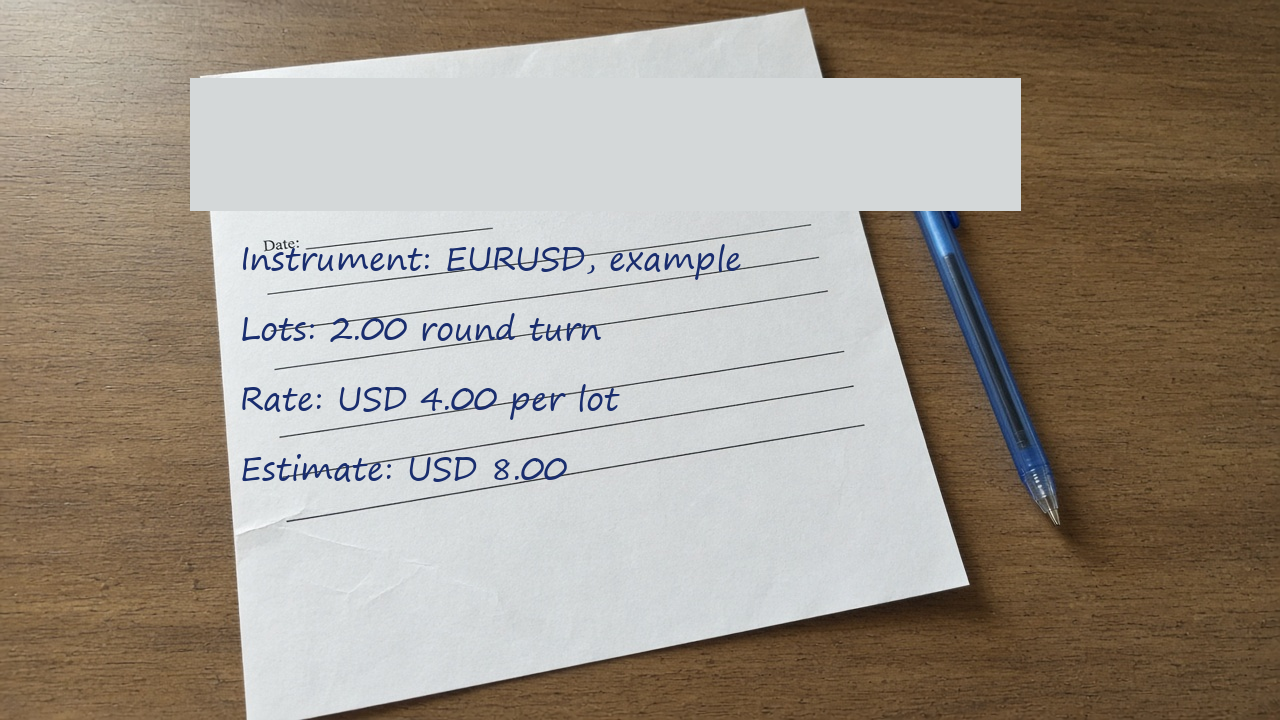
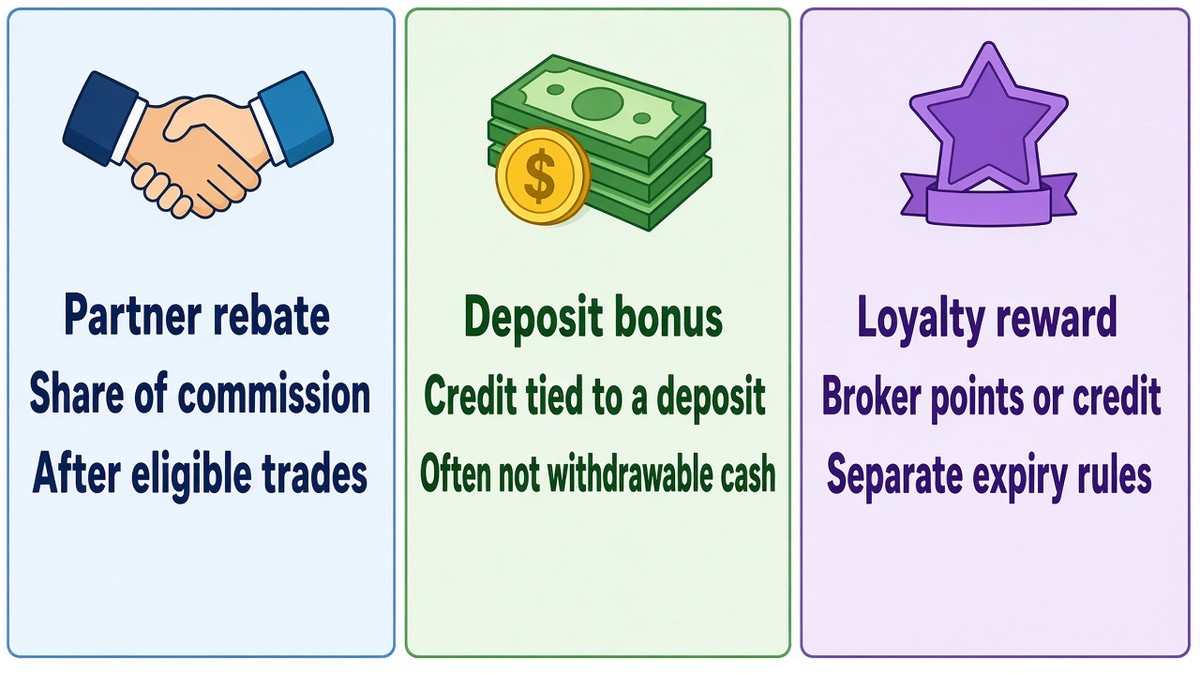
A cashback payment is a separate credit against trading cost, and only after a published rate row names the symbol, the account, and the amount per lot. It is not subtracted from the 3,666.67 dollars before the position opens, and it does not make the trade safer. When that row exists, check the amount in the rebate calculator. When it does not, leave the margin unchanged.
For a resident of India, calculating 3,666.67 dollars does not create a permitted purpose under the Liberalised Remittance Scheme. The February 2022 release is about sending margin to an overseas exchange or overseas counterparty. A working calculator, an INR conversion, or a rebate rate does not replace the authorised-person and Alert List check.
Before you trust the result
Read the company name on the agreement. The 30:1 major-FX cap above is the retail schedule in this Cyprus disclosure.
Read contract size on the symbol. Do not assume 100,000.
Use the opening price on the ticket, not 1.10000 and not 1.28390.
Divide by the leverage ratio, or multiply by the margin percent, and do not blend the two.
Leave rebate out of the margin line.
Contracts for difference can lose the money posted to support them. The margin figure is the amount set aside to open the position. It is not a forecast of profit, and it is not a cap on loss beyond what that agreement’s negative-balance clause actually says.
Questions
What does an XM margin calculator actually multiply?
Lots, contract size, and opening price. Divide that notional by the leverage on the agreement. On a standard forex contract the size is 100,000 units of the base currency, unless the symbol specification says otherwise.
Why does 3.33% not match dividing by 30?
1 divided by 30 is 3.333…%, and 3.33% is that figure rounded to two decimals. On a 110,000-dollar notional the gap is 3,666.67 dollars versus 3,663 dollars. Use the form the agreement actually states.
Does a larger lot raise margin in proportion?
Yes, while leverage and price stay the same. At the 1.10000 example and 30:1, 1.00 lot is 3,666.67 dollars, 0.10 lot is 366.67 dollars, and 0.01 lot is 36.67 dollars.
Can a Cyprus retail account use 1,000:1 on EURUSD?
Not on the retail schedule in this company’s risk disclosure. Major FX there is 30:1. A calculator that accepts 1,000:1 is not changing that schedule. Another agreement company can state a different maximum.
Is gold on the same 30:1 line?
No. In that retail table, gold is 5%, or 20:1, grouped with non-major FX. Shares are 5:1, and crypto indices and ETFs are 2:1. Read the row for the symbol you actually trade.
What if the account currency is not US dollars?
The formula still starts from lots, contract size, and price. The platform then converts the margin into the account currency. A USD example cannot be copied into a euro or rupee account without that conversion.
Does every account use a 100,000-unit lot?
No. Standard forex symbols usually show 100,000. Micro or cent settings can show a smaller contract. The specification on that symbol is the number to multiply.
Should I still use the disclosure’s 1.28390 price?
Only if you are checking that document’s own example. It produces a notional of 128,390 dollars and about 4,275 dollars of margin at 3.33%. A live ticket uses the price on the ticket.
Does cashback reduce the margin I must post?
No. A rebate applies only when a published row states the symbol, account, and amount per lot, and it credits trading cost. It is not deducted from required margin, and it does not change the leverage cap.
Does the result let an Indian resident send margin overseas?
No. The Reserve Bank of India’s 3 February 2022 release says margin remittances to overseas exchanges or overseas counterparties are not permitted under the Liberalised Remittance Scheme. The India article on this site is the place to check authorised persons and the Alert List.
What if equity falls below the margin the position needs?
On this disclosure, the company may issue a margin call and, at its stop-out level, close positions starting with the largest loss. It also says losses will not exceed the account balance under its negative-balance protection, and that it can raise margin requirements.
Which price belongs in the calculator?
The opening price on your ticket, plus the contract size and leverage from that symbol and that agreement. The 1.10000 figure in this article is only there so the division is easy to check.