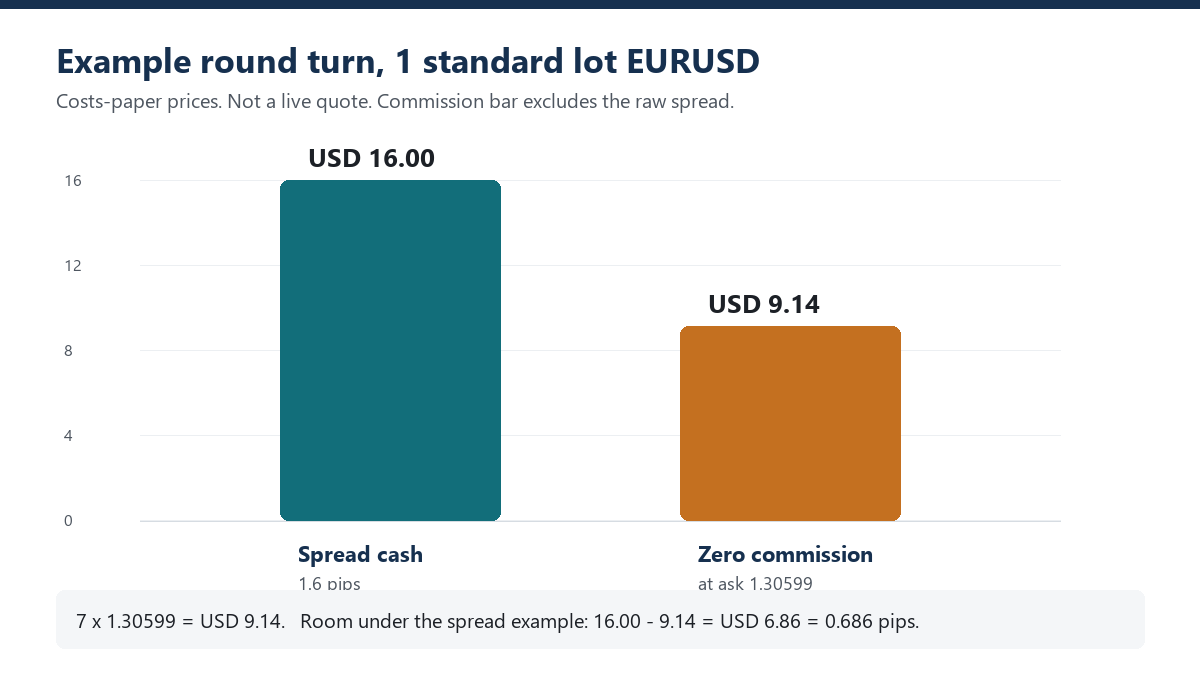
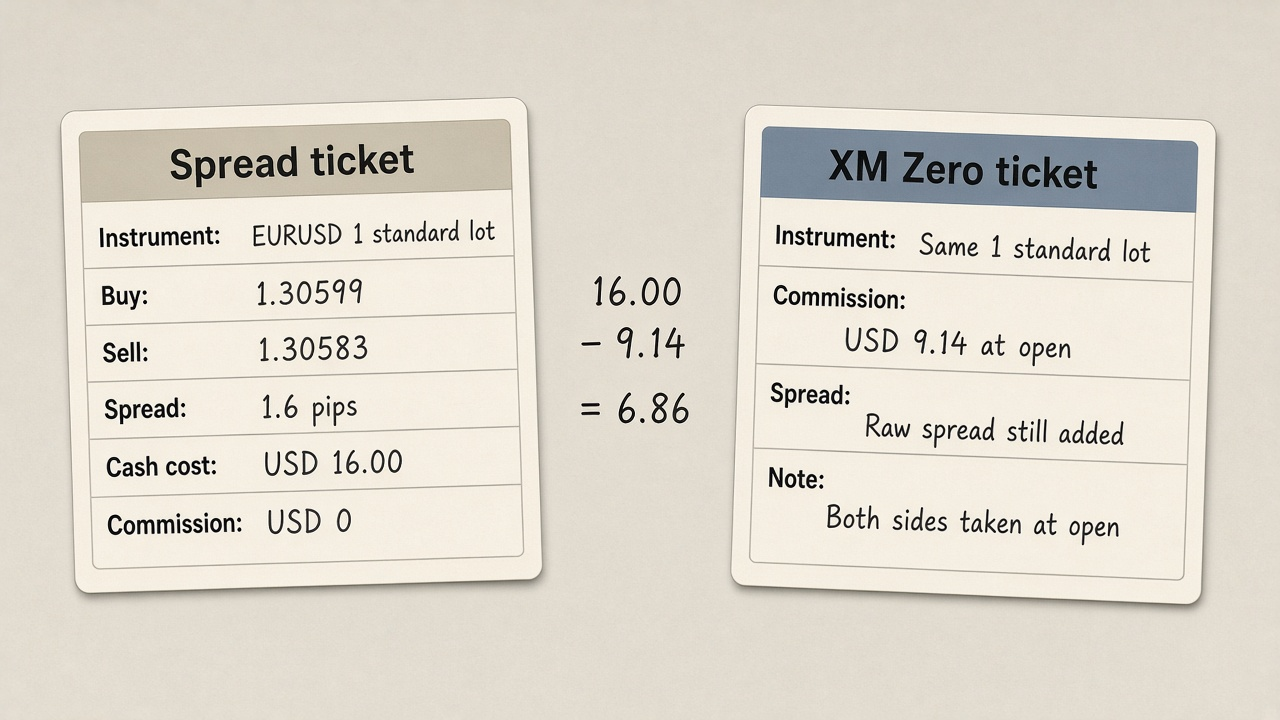
XM Spread vs Commission is a comparison of two separate charges on a round turn. In the worked EURUSD case in the UK costs and charges paper, a buy of one standard lot opens at 1.30599 and closes at 1.30583. The difference is 0.00016, which is 1.6 pips, and the paper prices it at USD 16 using 100,000 × 0.0001 × 1.6. The commission section of XM's costs and charges document names a commission for XM Zero only. At that same ask, one standard lot of euro is a dollar size of 130,599, and the Zero formula comes to USD 9.14, taken in full when the position opens. The USD 9.14 still leaves out whatever raw spread Zero is quoting.
That commission account costs less than the USD 16 example only when its raw spread costs less than the USD 6.86 left over. On a quote where one pip is USD 10, USD 6.86 is 0.686 pips. A cashback booked on xmforexcashback.in comes off after the broker's total. The company on the client agreement is the company whose schedule you use.
Leveraged forex and CFD trading can lose the money you deposit. For a resident of India the cheaper line is the later question. The RBI Alert List names XM. The prices below are the papers' worked example, so they will differ from the bid and ask on a ticket today.
How to compare XM Spread vs Commission on one round turn
Use one open and one close, and write both charges in the account currency. A spread is the gap between the buy price and the sell price. A buy opens at the ask and closes at the bid, so a round turn that goes nowhere still pays that gap once. The UK paper says XM uses variable spreads, which tend to be tighter in ordinary conditions and can widen around news, political uncertainty, the end of the business day, and weekends.
The Zero commission is a dollar amount tied to the size of the trade. The costs document sets it at USD 3.50 for the open and USD 3.50 for the close on each USD 100,000, and it deducts both amounts when the trade opens. You do not wait for the close to see the second half leave the account.
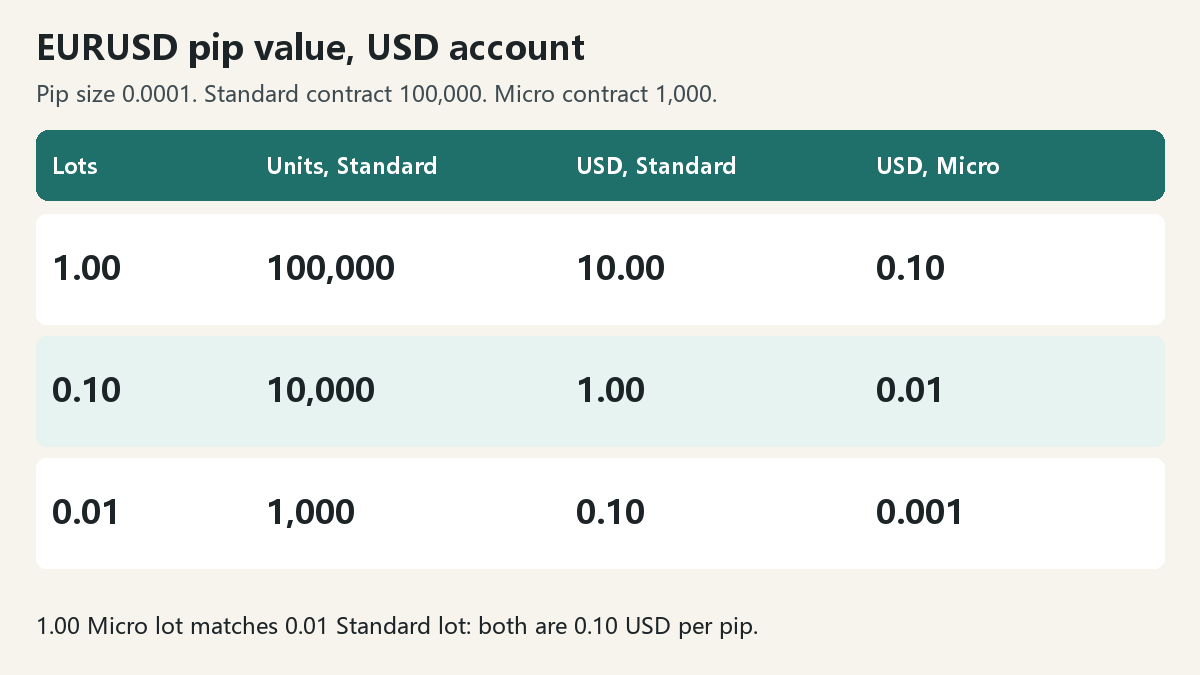
Three habits wreck the comparison. An "as low as" column is a floor, while 1.6 pips is one printed snapshot. USD 7 a lot is exact only when the dollar notional is 100,000. And a micro lot, where some XM definitions set one lot at 1,000 units, is a different size from the 100,000-unit standard lot in the spread example. The spread guide shows how to turn a pip gap into cash. The commission guide shows the formula and the account name it is attached to.
What the costs papers actually price
The UK paper is issued by Trading Point of Financial Instruments UK Ltd, FCA licence 705428. Rebate notes and account-opening notes for this comparison are on xmforexcashback.in. A client agreement elsewhere in the group can name another company. One of those agreements names XM Global Limited, a licensee of the Financial Services Commission in Belize, and public copies do not all print the same licence number. Read the number on the agreement you are given. If that company is not the UK firm, keep the method and replace the figures with that company's schedule.
| Piece | Spread example | Zero commission at the same ask |
|---|---|---|
| Prices | Buy 1.30599, sell 1.30583 | Ask 1.30599 used only to size the dollars |
| Spread | 1.6 pips, USD 16.00 | Still has to be added from the Zero quote |
| Commission | USD 0 in this example | USD 9.14, both sides at the open |
| Left over | The whole USD 16 is the spread cost | USD 6.86 of room before the totals match |
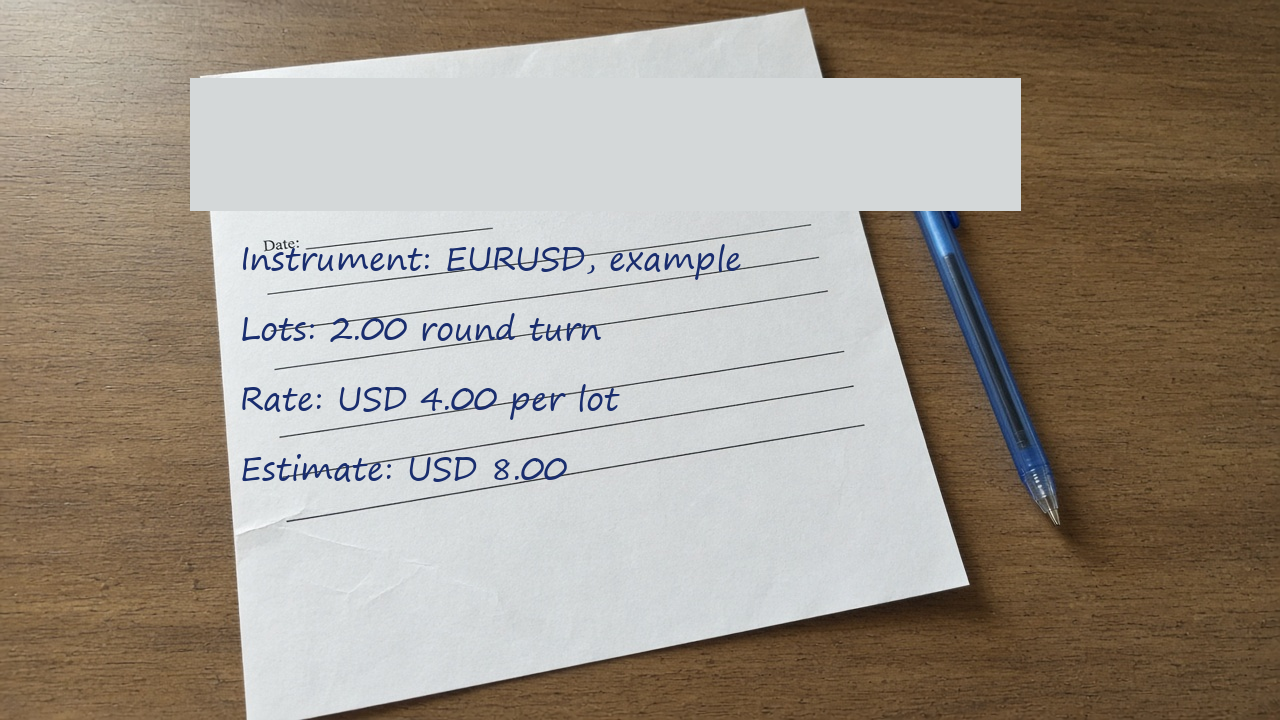
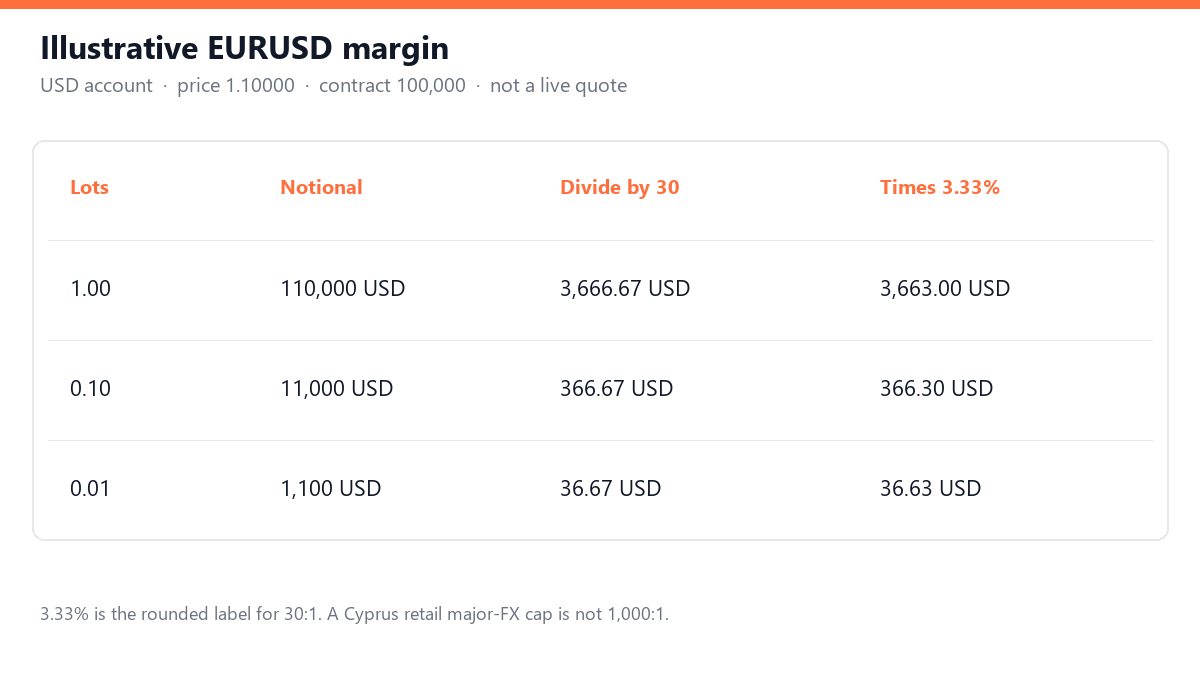
The commission arithmetic is 7 × 1.30599 = USD 9.14193, which is USD 9.14 to the cent. The same document's own euro example makes the point without that rounding. A buy of 2 lots of EURUSD at 1.10000 is a dollar size of 220,000, and the commission is 2 × (3.50 × 220,000 / 100,000) = USD 15.40. That is USD 7.70 a lot, because the euro price is above 1. A buy of 3 lots of USDJPY is USD 21, USD 7 a lot, because each lot is already USD 100,000.
The pip gap that decides which line is smaller
Where one pip on one standard lot is USD 10, the usual case for EURUSD, the commission account undercuts the USD 16 example when the raw-spread cash plus USD 9.14 is under USD 16. That leaves USD 6.86, or 0.686 pips, for the raw spread.
| Zero raw spread | Spread cash | Plus USD 9.14 | Against the USD 16 example |
|---|---|---|---|
| 0.6 pips | USD 6.00 | USD 15.14 | Lower |
| 0.686 pips | USD 6.86 | USD 16.00 | Level |
| 0.7 pips | USD 7.00 | USD 16.14 | Higher |
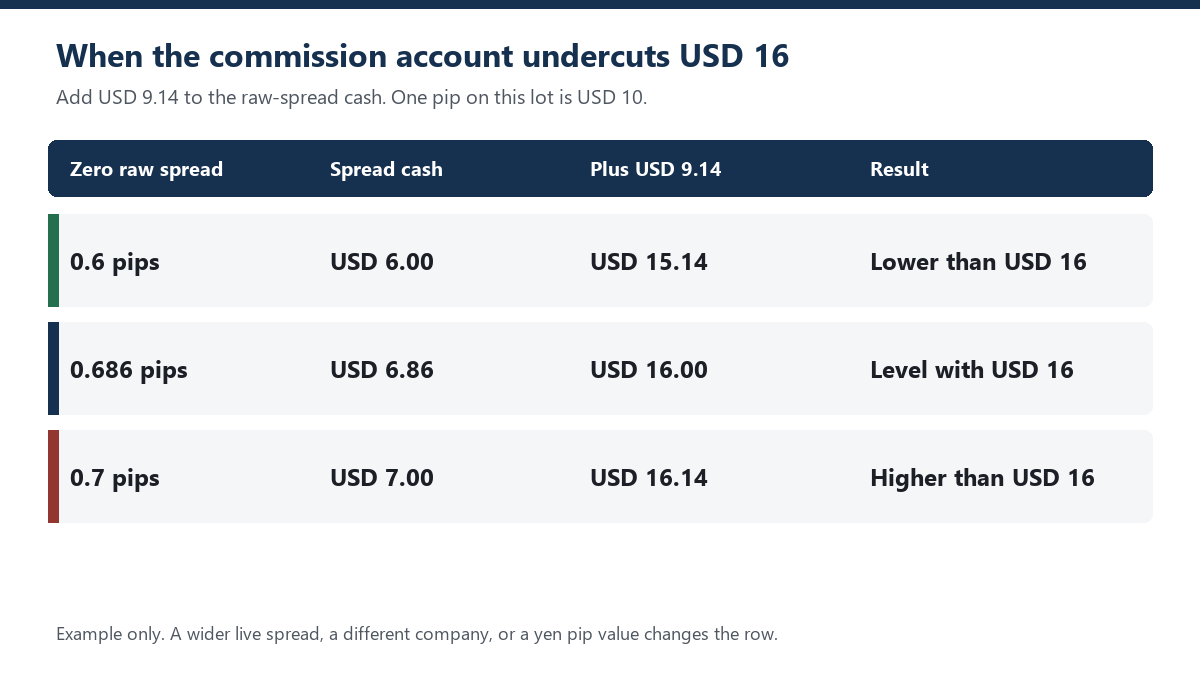
Rebuild both sides before you reuse 0.686. It slips when the live spread is wider than 1.6 pips, when one pip is not worth USD 10, and when the agreement's commission table is a different document. USDJPY is the clearest pip trap: the paper's three-lot commission is a clean USD 21, and the dollar value of one yen pip still depends on the exchange rate. A 0.10 lot scales both the USD 16 and the USD 9.14 by about a tenth if the notional scales, so the winner can stay the same while the dollar gap shrinks. A rebate that is a fixed cash amount per lot can change the winner. A rebate that scales with volume usually will not.
Account names that leave the comparison open
The account types page lists Standard and Ultra Low, each with a stated minimum deposit of $5, and a Shares account at $10,000. Zero is absent from that menu. The commission section used above names XM Zero. It does not name Standard, Ultra Low, or Shares. Ultra Low's blurb talks about low spreads and lower swap fees and commissions. That sentence is advertising. The schedule is the commission section that matches your agreement.
The account-type comparison is the place to see which nickname is on the current menu and which nickname lives on the costs paper. A Shares ticket is a stock product with its own minimum. This comparison stays with forex, where the spread example and the Zero formula can sit on the same lot.
Where a rebate changes the net
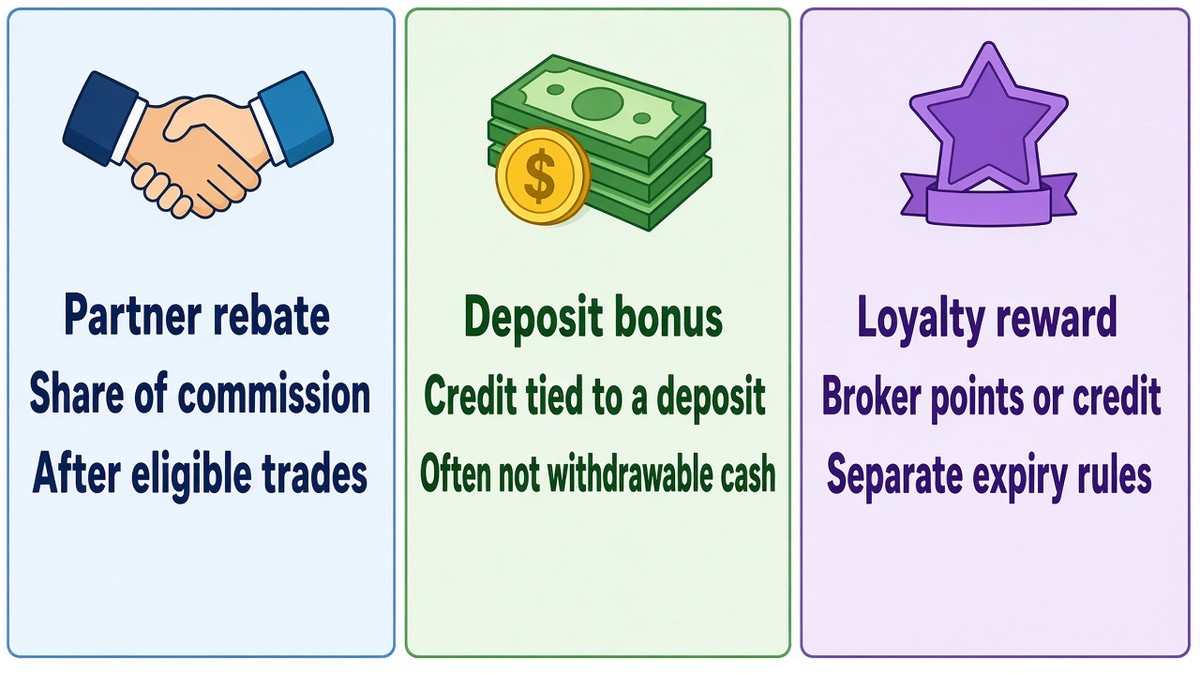
Start from the broker cost on the trades that qualify: spread cash, plus the Zero commission if that is the account, plus any swap if the position was held through the cutoff. Subtract only the rebate those trades earn under the programme written on xmforexcashback.in. The XM rebate profile is where the account-opening notes and the programme rate sit. Run the same lots through the forex rebate calculator after you have read how that rate is quoted.
The per-lot net-cost guide is the check for a round-turn rate versus a per-side rate, and for a platform lot that the programme does not count as eligible. A cashback payment does not rewrite the spread on the ticket, and it does not shrink a loss down to the size of the rebate.
Charges that sit outside both lines
A spread-versus-commission ranking that stops at the open will understate a trade you keep overnight. Swap, or rollover, is the financing line for a position still open at 22:00 GMT. That is 3:30am India Standard Time. Open at 21:59 GMT and that night's swap is in. Open at 22:01 GMT and it waits until the next cutoff. The swap guide covers the three-day currency charge used to account for the weekend.
Conversion is the other quiet line. The paper's examples are in US dollars. If the account currency is different, the commission and the spread cash still have to be converted before you compare them with a rebate paid in another currency. None of these lines is a reason to treat the 1.6 pip snapshot as a standing quote.
What residents of India read before either cost
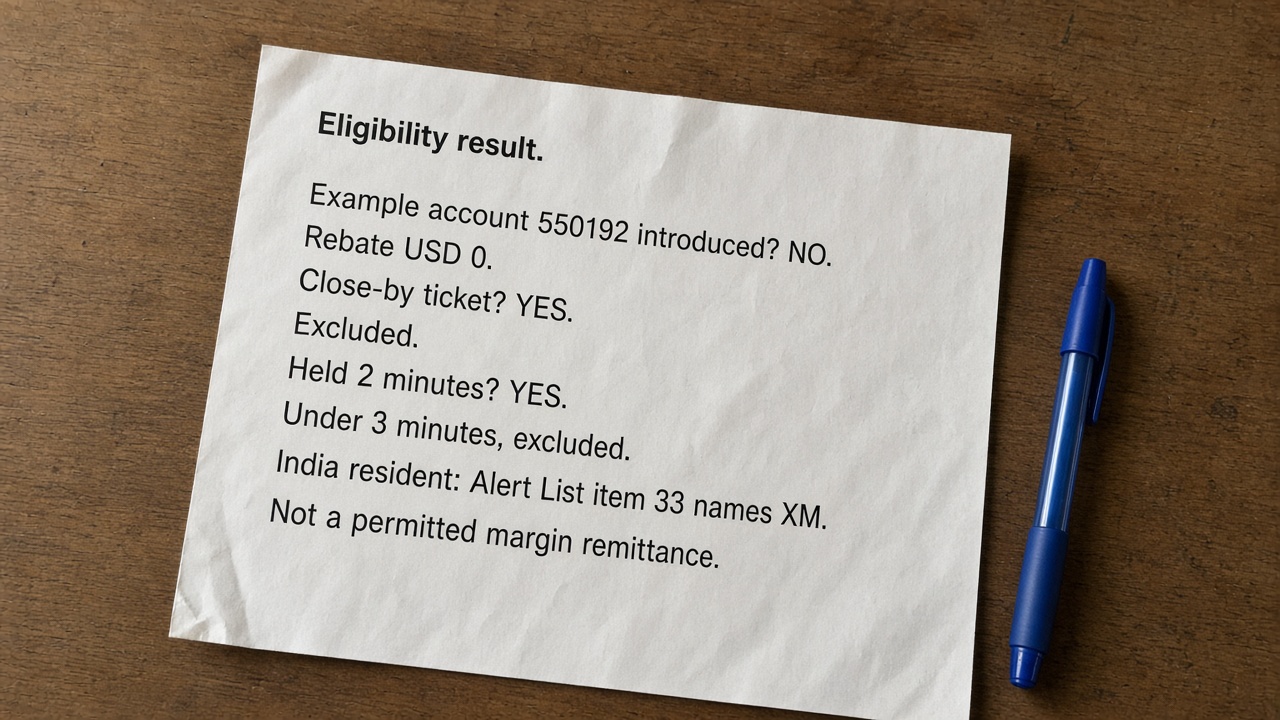
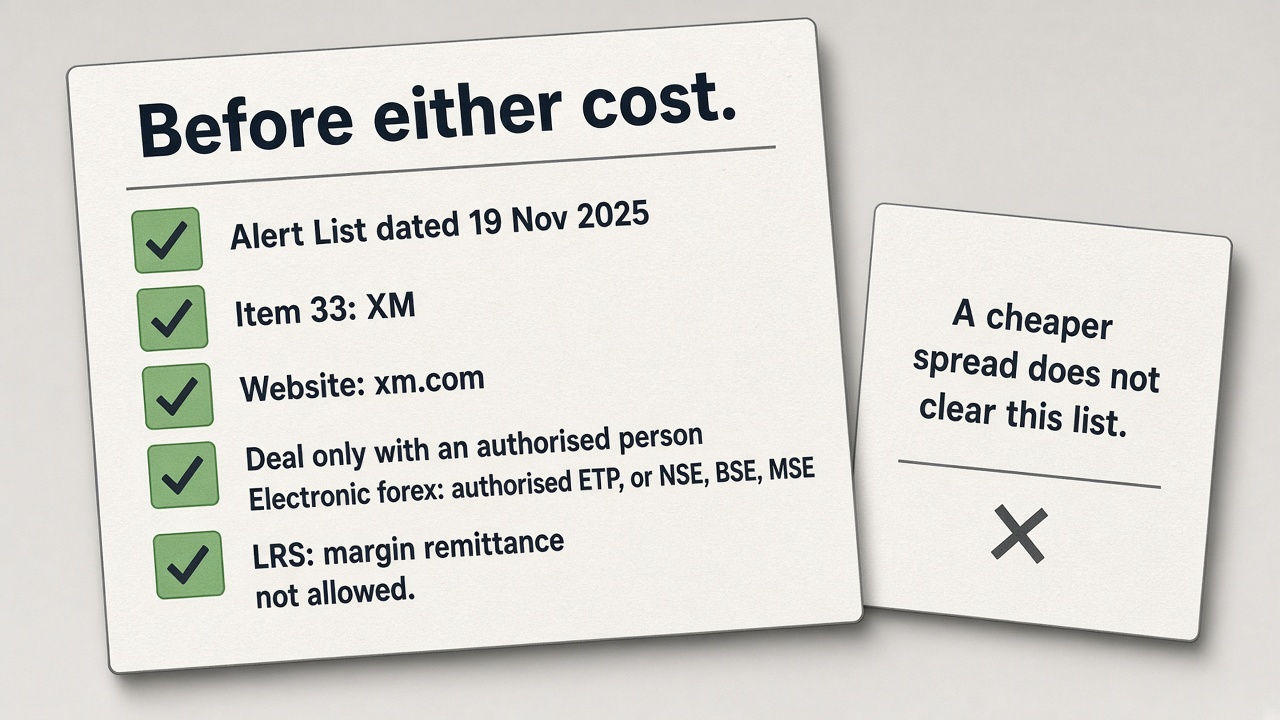
The Alert List page dates itself 19 November 2025. Item 33 is XM, with the website xm.com. The list is for names that are not authorised to deal in forex under the Foreign Exchange Management Act, 1999, and not authorised to operate a forex electronic trading platform. It also includes names that promote those platforms. The page says the list is not exhaustive, and absence from it is not an authorisation.
The Foreign Exchange Transactions FAQ, dated 28 August 2024, says resident persons may undertake forex transactions only with authorised persons and for permitted purposes. Electronic forex belongs on an electronic trading platform the RBI has authorised, or on NSE, BSE, or MSE. The FAQ says dealing with an unauthorised person, or on an unauthorised platform, can bring penal action under FEMA.
The Liberalised Remittance Scheme master direction, dated 6 September 2024, says remittances for margins or margin calls to overseas exchanges or an overseas counterparty are not allowed under the Scheme. A smaller spread does not amend that paragraph. The longer status check is whether XM is regulated in India. Read it before any account-opening step on this site. A demo can show a bid and an ask. It leaves the permission question where the RBI put it.
FAQ
How do you compare XM Spread vs Commission without using an "as low as" spread?
Take the spread on the symbol you would actually trade, convert that pip gap into money for your lot, and place the Zero commission beside it only if your agreement uses that account. The papers' 1.6 pip line is one worked snapshot worth USD 16 on a standard EURUSD lot. An "as low as" figure is a floor from a marketing table. Add the raw spread on the commission account before you call a winner, then subtract a rebate only if the programme counts those trades.
Is the USD 16 figure a live EURUSD price?
It is the UK costs paper's worked example: buy at 1.30599, sell at 1.30583, a gap of 1.6 pips, priced with 100,000 × 0.0001 × 1.6. The paper also says spreads are variable and can widen when liquidity thins. Use the example to learn the arithmetic, then read the bid and ask on the symbol in the account your agreement actually offers.
Does every XM account pay the Zero commission?
The commission section reviewed here names XM Zero. It sets USD 3.50 a side on each USD 100,000 and takes both sides at the open. That section does not put the same line on Standard, Ultra Low, or Shares. The current account-types page lists Standard, Ultra Low, and Shares, and it does not list Zero. If your agreement uses a different menu, follow that menu.
Why is the commission USD 9.14 here, and USD 7 in other examples?
The formula follows dollar notional, not the nickname "one lot". At an ask of 1.30599, one standard lot of EURUSD is USD 130,599, and 7 × 1.30599 is USD 9.14 to the cent. The paper's own case of 2 EURUSD lots at 1.10000 is USD 15.40, or USD 7.70 a lot. USD 7 a lot appears when the notional is exactly USD 100,000, as in the paper's 3-lot USDJPY case, which totals USD 21.
When does the commission account cost less than the USD 16 example?
On this EURUSD lot, where one pip is USD 10, the raw spread on the commission account has to cost less than USD 6.86. That is 0.686 pips. A raw spread of 0.6 pips plus USD 9.14 is USD 15.14. A raw spread of 0.7 pips plus USD 9.14 is USD 16.14, which is already above the spread example. The test assumes the same lot, the same pip value, and the commission table quoted here.
Does the USD 9.14 already include the spread?
No. USD 9.14 is the commission at that ask. The costs document treats the spread as a different charge. A Zero quote can be very tight and can also widen. Until you add the raw spread on that quote, the commission is only the dollar piece, not the round-turn total.
Does a smaller trade change which side wins?
If both the spread cash and the commission scale with notional, the ratio stays put and the dollar gap shrinks. A 0.10 lot is about a tenth of the standard-lot figures above. The winner can change when a rebate is a fixed amount per lot, or when the account's "one lot" is 1,000 units rather than 100,000 and somebody still applies USD 7 to that smaller lot. Rebuild the formula with the contract size on the symbol.
What if the client agreement names a different company?
Use that company's cost schedule. The USD 16 example comes from the UK paper of Trading Point of Financial Instruments UK Ltd. Other agreements in the group name other companies, including XM Global Limited in Belize. Licence numbers on public copies do not all match, so the number that matters is the one printed on the agreement you accept. The method, spread cash plus any commission, still applies. The figures may not.
Where does cashback sit in XM Spread vs Commission?
After the broker's cost, and only for trades the programme counts. Add the spread cash and, where it applies, the commission and any overnight swap. Then subtract the rebate documented for that account and symbol on xmforexcashback.in. Check whether the rate is per side or per round turn before you multiply. The payment does not change the price you were filled at.
Which costs are missing if I compare only spread and commission?
Overnight swap, if the position is open at 22:00 GMT, which is 3:30am India Standard Time. Currency conversion, if the account currency is not the dollar used in the examples. A spread that widens after the snapshot you wrote down. A dormant fee, where the costs paper charges one, is a separate inactivity line and is not part of this round-turn comparison.
Does a lower trading cost change the check for residents of India?
It does not. The Alert List dated 19 November 2025 names XM at item 33, website xm.com. The Foreign Exchange Transactions FAQ says residents deal only with authorised persons and, for electronic forex, only on an authorised platform or on NSE, BSE, or MSE. The Liberalised Remittance Scheme does not allow remittances for margins or margin calls to an overseas exchange or overseas counterparty. A tighter spread leaves those sentences as they are.
Can I treat Ultra Low as a commission account because the blurb mentions commissions?
The blurb is not the fee table. The commission section used for the USD 9.14 figure names XM Zero and leaves Ultra Low out. Standard is in the same position: it is on the account menu, and it is outside that commission section. Confirm the account name on your agreement, then use the schedule for that name. A marketing line about "lower commissions" is not a rate.
Should a Shares account be ranked in this forex comparison?
No. The account-types page lists Shares with a stated minimum deposit of $10,000, separate from the $5 minimum it prints for Standard and Ultra Low. Share dealing has its own contract size. Putting an unknown share fee next to a 1.6 pip EURUSD example would mix two products. Keep this ranking on forex lots you can price with the spread formula and, where it applies, the Zero formula.
Does holding through the weekend change a spread-versus-commission result?
It can, because swap is a third charge. The costs document applies rollover at 22:00 GMT and uses a multi-day charge on a set weekday so the weekend is not ignored. Two accounts can show the same spread-plus-commission total at the open and a different result on Wednesday morning in India. Add the swap from the symbol's long or short rate before you treat the round-turn ranking as the full cost of a held trade.